
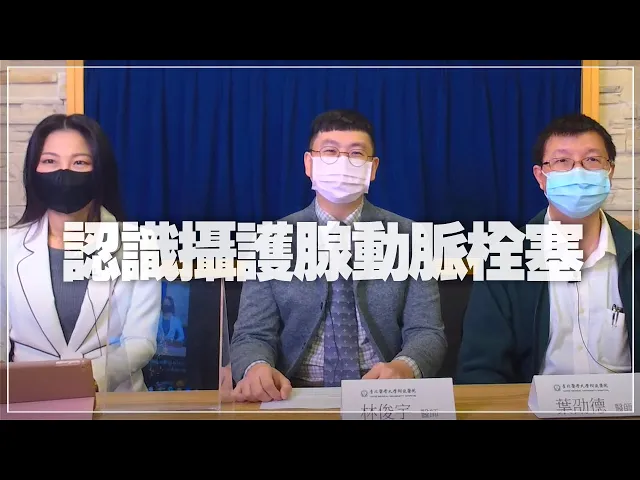
"News98 Famous Doctors On Call" - Dr. Lin Chun-yu Discusses Prostate Artery Embolization: From Diagnostic Imaging to PAE Minimally Invasive Treatment
On November 24, 2021, Dr. Jiun-Yu Lin, who currently serves as the attending physician for PAE at Sunrise Clinic, was invited to participate in the News98 "Famous Doctors On Call" program. Together with Dr. Shao-De Yeh, who was then the Director of the Urology Department at Taipei Medical University Hospital, they co-introduced Prostatic Artery Embolization (PAE).
This interview also remains a public record of Dr. Jiun-Yu Lin's long-term commitment to prostate artery embolization treatment.
What options are there for benign prostatic hyperplasia besides medication and transurethral surgery?
Common symptoms of benign prostatic hyperplasia include frequent urination, nocturia, weak urine stream, hesitancy, and incomplete emptying. In severe cases, urinary retention may occur, requiring the use of a urinary catheter.
There is no single way to treat it.
When symptoms are mild, they can first be controlled with medication. If symptoms continue to impact daily life, different minimally invasive treatments or surgical options need to be evaluated based on prostate size, bladder function, overall health status, and patient needs.
PAE (Prostatic Artery Embolization) is one of the methods that approaches treatment from the "blood vessels."
Why is PAE performed by diagnostic and interventional radiologists?
Prostatic artery embolization does not enter the prostate through the urethra, nor does it directly excise prostate tissue.
An interventional radiologist establishes a catheter pathway through blood vessels, searches for the arteries supplying the prostate under angiography image guidance, and then selectively delivers a microcatheter into the target vessel for embolization.
Prostatic arteries are usually very small, and vascular anatomy can vary from person to person. Therefore, the treatment is not just about "operating a catheter."
Before actually entering the blood vessels, the physician must first understand the patient's imaging, prostate size, and pelvic vascular anatomy. During the treatment, angiography must be used continuously to confirm the catheter position and the direction of blood flow.
This is precisely where diagnostic imaging and interventional radiology merge.
From the 2021 News98 interview to continuous dedication to PAE treatment
This News98 interview was broadcast in 2021. At that time, Dr. Jiun-Yu Lin introduced PAE to the public as a physician of the Prostatic Artery Embolization Team at Taipei Medical University Hospital.
Since then, Dr. Jiun-Yu Lin has continuously dedicated himself to clinical treatments and professional exchanges related to prostatic artery embolization.
In 2022, Dr. Jiun-Yu Lin won the Taiwan Society of Interventional Radiology (TSIR) Rising Star Championship Award for a prostatic artery embolization case and has shared his treatment experiences at the Taiwan Society of Interventional Radiology, the Taiwan Urological Association, and the Taiwan Society for Vascular Surgery.
Currently, Dr. Jiun-Yu Lin performs PAE (prostatic artery embolization) and other vascular interventional treatments at Sunrise Clinic.
Sunrise Clinic PAE: From Preoperative Image Evaluation to Vascular Interventional Treatment
PAE is not suitable for all patients with benign prostatic hyperplasia.
Before deciding whether to undergo treatment, it is necessary to first confirm whether the current urinary symptoms are indeed related to benign prostatic hyperplasia, while evaluating prostate volume, PSA, bladder and voiding functions, as well as pelvic vascular conditions.
Sunrise Clinic is located in Da'an District, Taipei City. The clinic is equipped with an angiography suite and GE OEC 3D C-arm image-guided equipment, where Dr. Jiun-Yu Lin performs prostatic artery embolization.
For patients who have undergone medical treatment but still have significant symptoms, those with large prostate volume, a history of urinary retention, or those who wish to learn more about different treatment options, they can first complete a urological and imaging evaluation before discussing whether PAE is a suitable treatment option.
Extended Reading
Media Source: News98 News Station "Famous Doctors On Call"
Program Topic: Understanding Prostatic Artery Embolization
Broadcast Date: November 24, 2021
Interviewees: Director Shao-De Yeh, Dr. Jiun-Yu Lin
