
What is the difference between TAME microvascular embolization and long-term steroid pain relief? Action mechanisms, applicable situations, and evaluation methods
What is the difference between TAME microvascular embolization and long-term steroid pain relief? Action mechanisms, applicable situations, and evaluation methods
Article Summary
For those who have been plagued by intractable pain for a long time and have tried various conservative treatments, "coexisting peacefully with pain" is not necessarily the only answer.
TAME (Transcatheter Arterial Micro-Embolization) is one of the interventional treatment options for this type of pain. The goal is to reduce abnormally proliferating microvessels around the joints, thereby decreasing persistent inflammation and pain signals. Whether it is suitable for you requires an evaluation by a physician; this article explains the differences between TAME and long-term steroid pain relief, which situations are suitable for evaluation, and how the treatment is performed.
What is intractable pain? Which groups are suitable for TAME evaluation?
Intractable pain refers to pain that has persisted for a long time, responds poorly to conventional treatments, and significantly affects daily life. The causes may include chronic inflammation, nerve hypersensitivity, or abnormal local tissue structure. Clinical evaluation criteria include pain persisting for more than three months that has already affected sleep, work, or exercise.
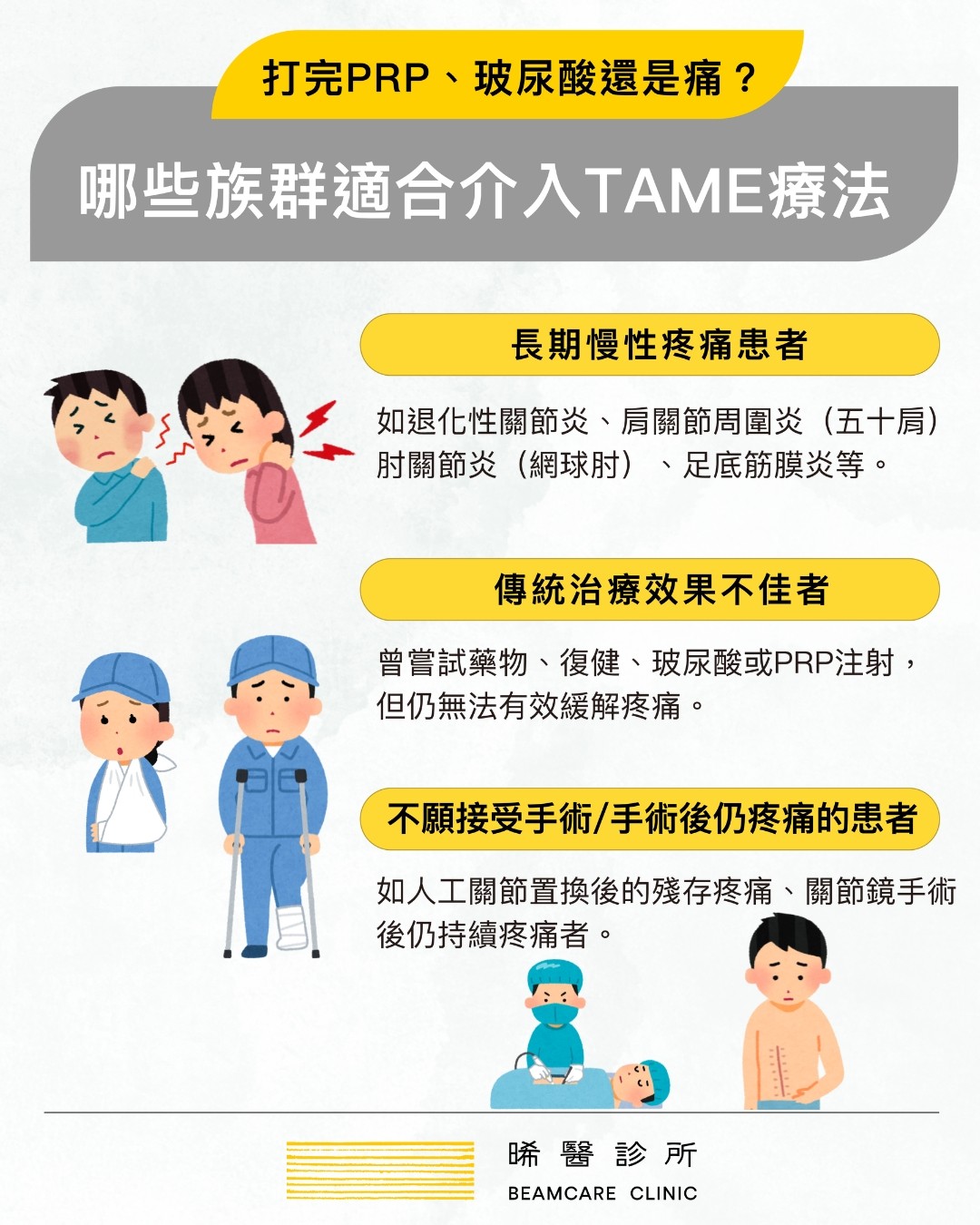
There are three common groups suitable for evaluation: First, those with long-term chronic pain in areas such as degenerative arthritis, frozen shoulder, tennis elbow, trigger finger, and plantar fasciitis; second, those who have tried medication, physical therapy, hyaluronic acid, or PRP injections but still experience limited effectiveness; third, those who do not wish to undergo surgery directly, or who continue to experience pain after joint replacement or arthroscopic surgery. It should be noted that TAME has specific indications and is not suitable for all chronic pain; it must still be determined by a physician based on medical history, physical examination, and imaging.
Why does long-term steroid injection for pain relief become increasingly less effective?
Because steroids suppress the inflammatory response, not all sources of pain.
After joints or tendons undergo long-term wear and tear and degeneration, in addition to local inflammation, abnormally proliferating microvessels may also appear, accompanied by newly formed nerve endings that continuously emit pain signals. Steroid injections can temporarily suppress inflammation, but they have no effect on these abnormal blood vessels and nerve structures. Therefore, some people experience a cycle of "it works after injection, but the pain returns after a while, and the effective duration becomes shorter and shorter."
Additionally, repeated steroid injections in the same area have cumulative considerations, such as the impact on tendons and surrounding tissues, which is why clinical practice usually controls the frequency and total number of injections. Whether to continue injections and at what intervals should be discussed with your physician; you do not need to and should not make the decision to stop medication on your own.
What is the difference in the mechanism of action between TAME and steroids?
In one sentence: Steroids handle inflammation, while TAME handles abnormal blood vessels. The approach of TAME is to deliver embolization medication to the abnormally proliferating microvessels under image guidance, causing these vessels to shrink, with the goal of reducing the source of pain signals and alleviating the persistent local inflammatory state.
Therefore, the relationship between the two is not "which one is stronger," but rather that they target different objects. If the primary source of pain is acute inflammation, steroids have a role to play; if conservative treatments are repeatedly performed with limited effectiveness, the source of pain may be related to abnormal blood vessel proliferation, at which point TAME enters the options for evaluation. Which one is suitable must be determined by a physician based on medical history, physical examination, and imaging; they are not mutually exclusive alternatives. If pain recurs after treatment, whether to undergo TAME again is also evaluated by the physician based on the situation at that time.
Are post-operative pain and chronic pain caused by sports injuries also within the scope of evaluation?
Yes. In addition to chronic pain caused by degeneration and wear and tear, long-term pain caused by the following conditions can also be included in the evaluation:
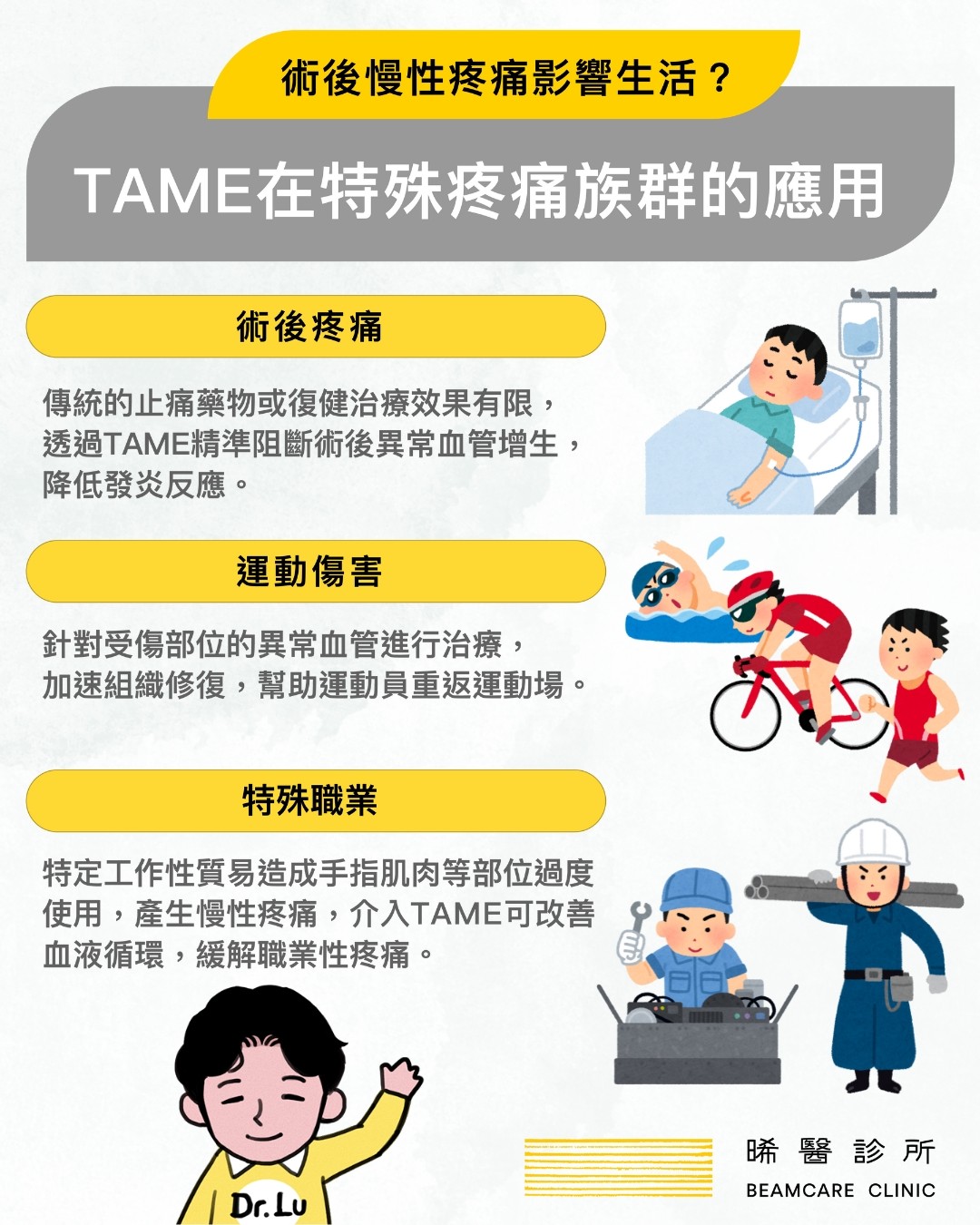
Post-operative pain: Some patients still have residual pain after surgery, and pain medications or physical therapy offer limited improvement. If this type of pain is related to local abnormal blood vessel proliferation, TAME is an option that can be discussed with a physician.
Sports injuries: Joint, muscle, or ligament damage caused by long-term high-intensity training or accidents can sometimes turn into chronic pain, which can be evaluated by a physician to see if the source of pain is suitable for TAME treatment.
Occupational wear and tear: Certain occupations place long-term stress on specific areas due to work patterns, such as musicians who play the saxophone for long periods, where repetitive overuse of finger muscles accumulates to form chronic pain. This type of situation can likewise be included in the evaluation.
How is TAME treatment performed? Does it require hospitalization?
TAME is performed under local anesthesia. In most cases, hospitalization is not required, and patients can return home after a short period of observation. Catheter-based C-TAME is performed under the guidance of angiography equipment with cone-beam CT (3D tomography) function, using a microcatheter for selective embolization; the equipment used at He-Yi is the GE OEC 3D mobile C-arm. The simpler s-TAME is performed via injection under ultrasound guidance, without the need for catheter insertion. The physician will explain which method is suitable based on the depth and complexity of the painful area.
Additionally, it is important to note that TAME has specific indications and is not suitable for all chronic pain; it must still be determined by a physician based on medical history, physical examination, and imaging. Those who are allergic to contrast media, have poor kidney function, or are taking anticoagulant medications, please inform the physician proactively during the evaluation.
It is recommended to avoid heavy lifting and weight-bearing activities within one to two weeks after the procedure. The actual recovery time will vary depending on the area, treatment method, and work pattern, and the physician will explain the expected recovery period before treatment.
If I am still using steroids, can I stop the medication directly?
No, you cannot stop the medication on your own. Those who are currently using steroids (oral or injection), anticoagulants, or antiplatelet drugs, please fully inform the physician of your medication status during the TAME evaluation. Whether and how to make adjustments will be determined by the physician. Stopping medication on your own may bring risks to the control of the original disease, which is something that needs to be avoided even more than the pain itself.
How do I evaluate if I am suitable?
If your pain has persisted for more than three months, conservative treatment has had limited effectiveness, and you are temporarily not considering surgery, you can first undergo a pre-evaluation via LINE. Please bring past imaging data (X-rays, MRI, ultrasound) and treatment records during your clinic visit so that the physician can confirm the source of pain and discuss whether TAME or other treatment methods are suitable.
What else can be done besides treatment?
TAME addresses the link of abnormal blood vessels, but the management of long-term pain usually requires a multi-pronged approach. Physical therapy improves blood circulation and joint mobility through exercise, massage, and hot compresses; long-term pain can also easily affect mood, and if necessary, psychological counseling or support groups can assist with stress management. Lifestyle adjustments such as a balanced diet, regular exercise, and adequate sleep are also part of pain management. It is recommended to discuss a personalized treatment plan with your healthcare team and view TAME within the context of overall care rather than as a single solution.
Authoring Physician: Dr. Ping-Sheng Lu
Last Updated: August 6, 2026
Disclaimer: This article is for health education information purposes and cannot replace professional medical diagnosis and treatment advice. Whether any treatment is suitable should be determined after evaluation by a physician.
Yuji Okuno Micro-Embolization Thesis Reference Material:
Okuno Y, Korchi AM, Shinjo T, et al. Midterm clinical outcomes and MR imaging changes after transcatheter arterial embolization as a treatment for mild to moderate radiographic knee osteoarthritis resistant to conservative treatment. J Vasc Interv Radiol. 2017;28(7):995-1002. doi:10.1016/j.jvir.2017.02.033
