
Which areas is the simplified s-TAME suitable for? What ultrasound guidance can and cannot achieve
Which areas is the simplified s-TAME suitable for? What ultrasound guidance can and cannot achieve
Article Summary
Simplified s-TAME is an ultrasound-guided transcatheter arterial microembolization. It also targets the abnormally proliferating microvessels in chronically inflamed tissues; the difference lies in the method of entry and positioning.
What is Simplified s-TAME?
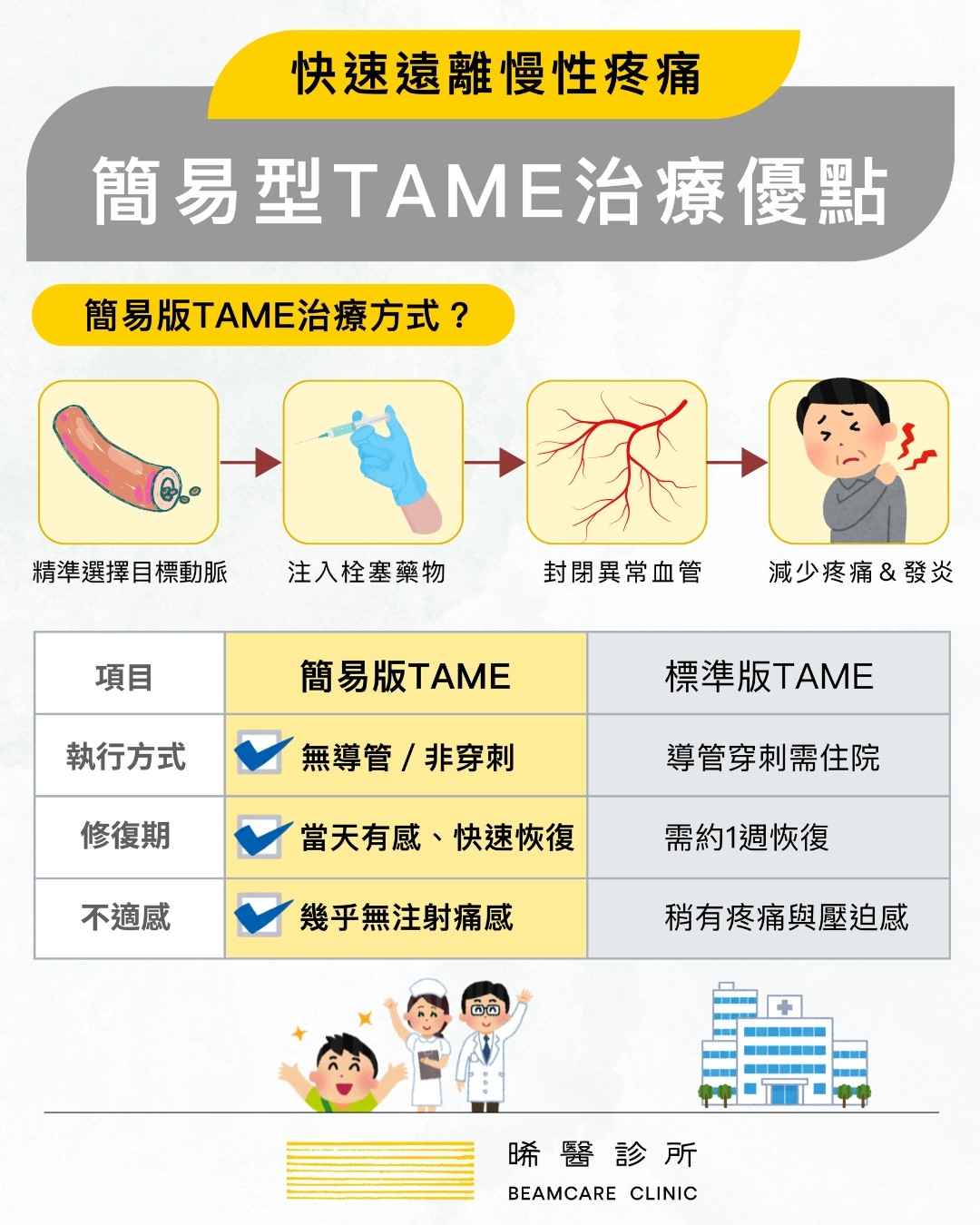
s-TAME is a simplified approach to transcatheter arterial microembolization: under ultrasound guidance, embolization medication is delivered via injection to abnormally proliferating microvessels to cause them to shrink. The goal is to reduce the source of pain signals and alleviate local inflammation. The entire process does not require catheter insertion into an artery, nor does it require contrast media injection.
Sites of chronic pain (such as chronically inflamed tendons or areas around joints) are often accompanied by abnormally proliferating microvessels and newly formed nerve endings, which is one of the reasons for recurrent pain. s-TAME addresses these abnormal blood vessels, which is identical to catheter-based C-TAME; the difference between the two lies in the procedure, not the underlying principle.

Why are some areas suitable for s-TAME while others are not?
The difference lies in whether it can be seen under ultrasound. s-TAME is performed under ultrasound guidance, so the target blood vessels must be within a depth and range that can be clearly visualized by ultrasound. For locations that are deeper or have more complex blood vessel pathways where ultrasound positioning is difficult, doctors will instead adopt catheter-based C-TAME, performing selective embolization using a microcatheter guided by angiography equipment.
The two are different pathways divided by location and condition, and it is not a matter of one being better than the other. Which one is actually suitable is determined by the doctor based on the site of pain, imaging results, and physical condition. For a complete comparison and selection criteria, please see "What is the difference between C-TAME and s-TAME?".
Additionally, s-TAME does not require the injection of contrast media, which is a factor that can be discussed with the doctor for individuals who are allergic to contrast media or have poor kidney function.
Which areas and conditions are suitable for s-TAME evaluation?
Commonly evaluated areas are the shallower and distal parts of the body: fingers, wrists, ankles, and soles of the feet. Common clinical examples include plantar fasciitis and long-term pain and swelling in degenerative finger joints. For this type of recurring pain where conservative treatment has limited efficacy, a doctor can evaluate whether it is suitable for s-TAME treatment.
Like all TAME treatments, s-TAME has specific indications and is not suitable for all chronic pain. Pain lasting for more than three months, with limited efficacy from medication or rehabilitation, is a common prerequisite for evaluation. If you are currently taking anticoagulant or antiplatelet medications, please proactively inform your doctor during the evaluation.
How is the treatment performed? Is hospitalization required?
s-TAME is performed in an outpatient setting under local anesthesia, completed with ultrasound-guided injection. Hospitalization is not required, and in most cases, patients can return home after treatment. Since arterial puncture and catheter insertion are not required, post-operative hemostasis and care are relatively simple. The actual recovery status and subsequent activity restrictions will vary depending on the treatment site and individual circumstances, which the doctor will explain prior to treatment.
Should rehabilitation be paired with the treatment?
It is highly recommended. s-TAME addresses the specific link of abnormal blood vessels; the recovery of joint mobility and muscle strength still needs to be established through rehabilitation training, which also helps reduce the chance of pain recurrence. After treatment, please arrange rehabilitation content according to the recommendations of your doctor and therapist, viewing s-TAME as one part of overall pain care.
How do I evaluate if I am suitable?
If your pain has persisted for more than three months, is located in areas like the fingers, wrists, ankles, or soles of the feet, and medication and rehabilitation have had limited efficacy, you can first complete a preliminary assessment via LINE. Bring your past imaging data (X-rays, MRI, ultrasound) and treatment records to your appointment, and the doctor will confirm the source of pain before discussing whether s-TAME, C-TAME, or other treatment methods are suitable.
Authoring Physician: Dr. Ping-Sheng Lu
Last Updated: August 6, 2026
Disclaimer: This article is for health education purposes only and cannot replace a physician's diagnosis and treatment advice. The suitability of any treatment must be evaluated and decided by a physician.
Yuji Okuno Transcatheter Arterial Microembolization Research References:
Sasaki T, Shibuya M, Miyazaki K, Nakata M, Kawabe A, Nakasone T, Sakai N, Okuno Y. Clinical results of ultrasound-guided intra-arterial embolization targeting abnormal neovessels for plantar fasciitis: 66 cases with up to 4 years of follow-up. Foot and Ankle Surgery. 2025;31(2):105-110. doi:10.1016/j.fas.2024.07.009
