
Taipei Medical University Hospital 'Health News' Publishes Dr. Lin Chun-yu's Special Article on PAE | From Imaging Diagnosis to Minimally Invasive Prostate Intervention
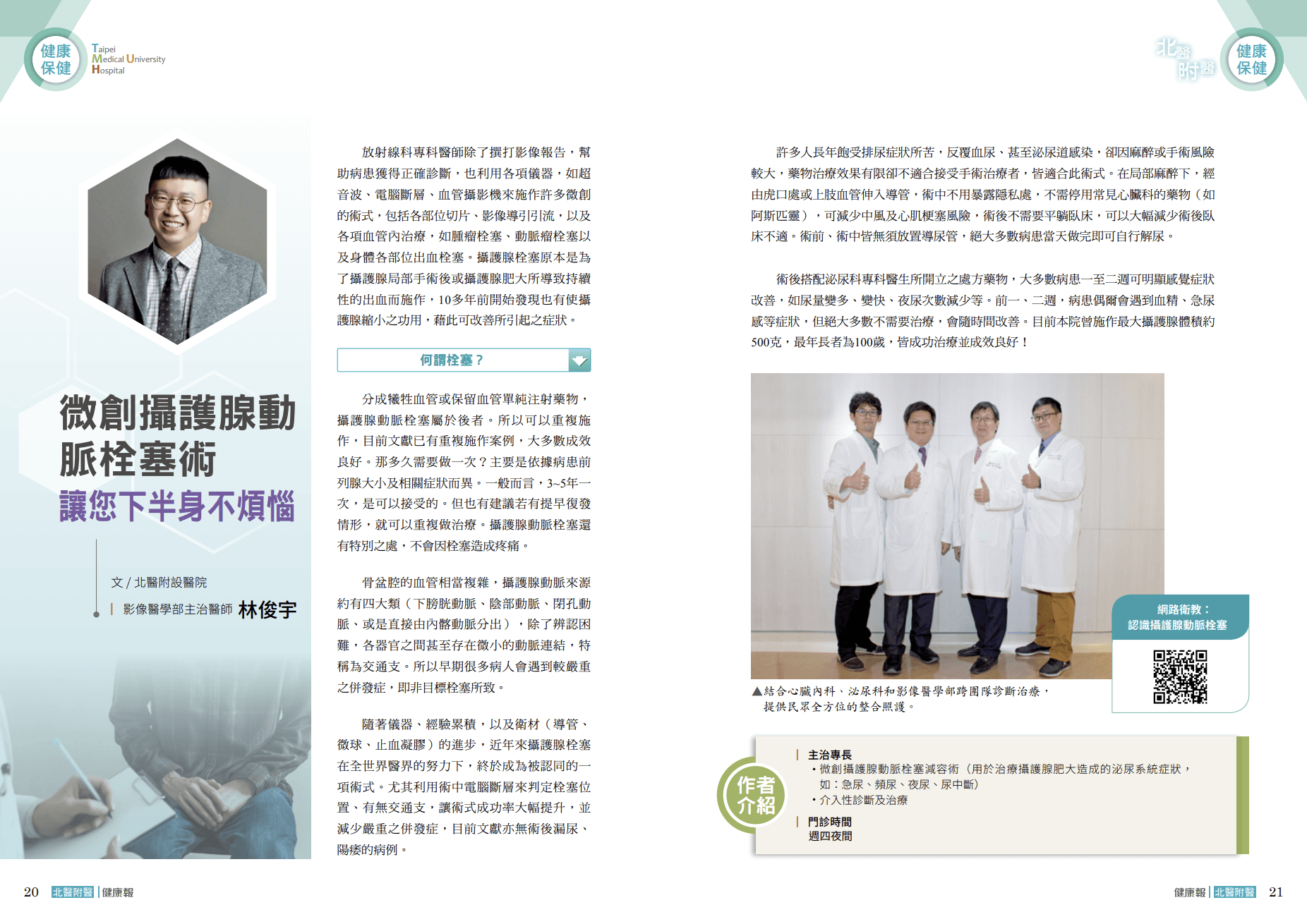
In June 2022, Dr. Lin Jiun-yu (Dr. Jiun-Yu Lin), currently practicing as the PAE attending physician at Xi-Yi Clinic, published a specialized article on "Minimally Invasive Prostatic Artery Embolization" in "Health News" of Taipei Medical University Hospital. From the perspective of an interventional radiologist, he introduced vascular intervention therapy for benign prostatic hyperplasia (BPH).
In addition to introducing PAE (Prostatic Artery Embolization), this article also answers a question unfamiliar to many patients:
What do diagnostic radiologists do besides reading X-rays, CTs, and MRIs?
Diagnostic Radiology: More Than Just "Reading Imaging Reports"
The general public's contact with radiology is usually after undergoing an X-ray, ultrasound, CT scan, or MRI, where they wait for the radiologist to interpret the report.
However, diagnostic imaging is only a part of radiology.
Dr. Lin Jiun-yu explained in the TMUH "Health News" that besides assisting in disease diagnosis through imaging, radiologists also utilize imaging equipment such as ultrasound, CT, and angiography to perform minimally invasive interventional treatments.
Examples include image-guided biopsy, drainage, tumor embolization, bleeding embolization, and various endovascular treatments.
PAE (Prostatic Artery Embolization) is one such application of interventional radiology.
The First Challenge of PAE: Actually "Finding the Correct Blood Vessel"
Prostatic artery embolization does not enter through the urethra, nor does it directly resect prostate tissue.
During treatment, the interventional radiologist establishes a catheter path through blood vessels, finds the arteries supplying the prostate via angiography, and selectively delivers microcatheters to the target location for embolization.
While "finding the prostatic artery" sounds simple, it actually requires a significant amount of experience in imaging interpretation and vascular anatomy.
The pelvic blood vessels themselves are highly complex, and the prostatic artery may originate from different vascular branches. Furthermore, the vascular pathways of each patient are not entirely the same.
In addition, there may be tiny collateral vessels connecting the area around the prostate with the bladder, rectum, and other pelvic organs.
Therefore, when performing PAE, it is not just about "finding a blood vessel," but more importantly confirming:
Is this the correct blood vessel supplying the prostate?
Where does the blood vessel go?
Are there branches connecting to other surrounding organs?
Is the embolization position precise enough?
These questions all rely on diagnostic imaging, angiography, and interventional radiology expertise to evaluate.
Why is PAE Performed by Radiologists?
The target of PAE treatment is benign prostatic hyperplasia, but the actual treatment pathway is "inside the blood vessels."
Therefore, a patient undergoing evaluation for PAE usually involves two major aspects simultaneously.
First, it is necessary to confirm whether the urinary symptoms are related to benign prostatic hyperplasia, including prostate volume, voiding function, PSA, and other urinary system issues.
On the other hand, if PAE is further considered, it is also necessary to evaluate the vascular anatomy of the pelvic and prostatic arteries, as well as whether the vascular conditions are suitable for catheter-based treatment.
This is why PAE particularly requires mutual collaboration between urological evaluation and interventional radiology expertise.
From TMUH to Continuous Dedication to Prostatic Artery Embolization
Dr. Lin Jiun-yu has long been dedicated to diagnostic imaging and vascular interventional therapy.
In 2021, Dr. Lin was invited to News98's "Famous Doctors On Call" to introduce prostatic artery embolization; in 2022, he wrote the specialized PAE article in TMUH's "Health News," and in the same year, he won the TSIR Rising Star Champion Award from the Taiwan Society of Interventional Radiology for a prostatic artery embolization case.
In 2024, Dr. Lin was again invited to the Civic Health Lecture organized by the Yonghe District Office of New Taipei City, giving a public health education talk on "New Minimally Invasive Treatment for Benign Prostatic Hyperplasia."
From medical centers, professional societies, and media interviews to public health lectures, Dr. Lin has continuously accumulated clinical treatment and health education experience in prostatic artery embolization.
Currently, he performs PAE (Prostatic Artery Embolization) and other vascular interventional treatments at Xi-Yi Clinic.
At Xi-Yi, PAE Evaluation is Not Just Asking "How Big is the Prostate?"
Having an enlarged prostate does not mean one must undergo PAE.
For patients, it is more important to first clarify the actual underlying cause of their current frequent urination, nocturia, weak urine stream, difficulty urinating, or urinary retention.
If after evaluation, further consideration is given to PAE, it is also necessary to confirm the prostate size, pelvic blood vessels, and prostatic artery anatomical conditions through imaging.
Therefore, the core of PAE is not merely "embolization."
The goal is to diagnose first, then look at the imaging; find the true problem first, and then decide whether intervention is needed.
This is also the critical role that diagnostic imaging and interventional radiology play in minimally invasive treatments.
Extended Reading
"News98 Famous Doctors On Call" Dr. Lin Jiun-yu Talks About Prostatic Artery Embolization
Source: Taipei Medical University Hospital "Health News"
Original Title: Minimally Invasive Prostatic Artery Embolization Relieves Your Lower Body Worries
Publication Date: June 2022
Original Author: Dr. Lin Jiun-yu, Department of Medical Imaging, Taipei Medical University Hospital
