A Remedy for Sports Injuries and Joint Degeneration? What Is “High-Concentration Glucose”? Doctor: Injecting It in the Wrong Place May Worsen Symptoms
A Remedy for Sports Injuries and Joint Degeneration? What Is “High-Concentration Glucose”? Doctor: Injecting It in the Wrong Place May Worsen Symptoms
Article Summary
1. A savior for sports injuries and joint degeneration? What is high-concentration glucose injection?
Due to an aging population and the growing popularity of sports, more and more people with sports injuries have sought medical care in recent years. Some even develop osteoarthritis, which can severely affect daily life. Regenerative medicine has also become a hot topic in recent years, and among it, high-concentration glucose prolotherapy injections have been widely used as one of the treatments for joint pain.
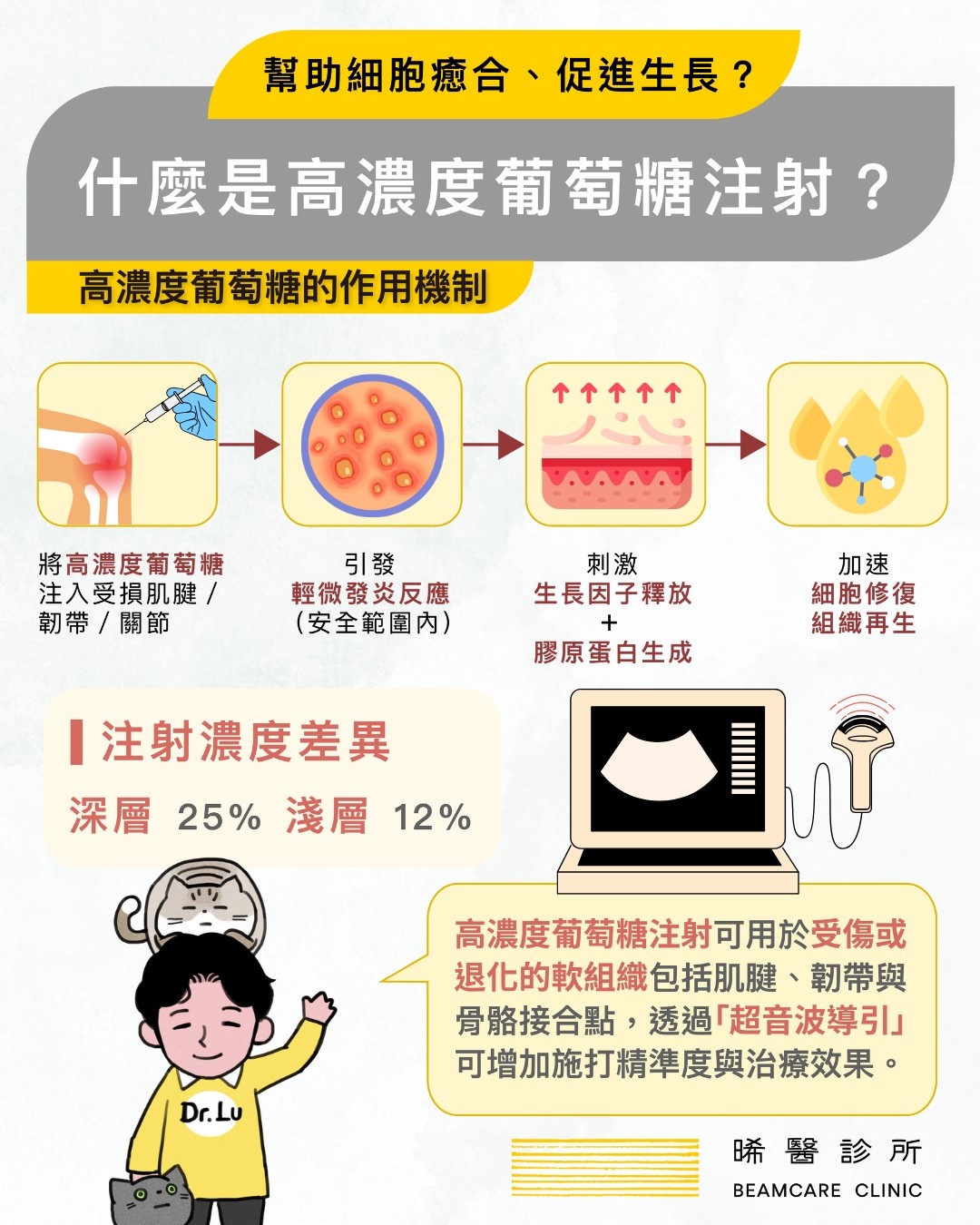
The main effect of high-concentration glucose prolotherapy is to stimulate the repair of the body's soft tissues, including tendons, ligaments, and articular cartilage. When high-concentration glucose solution is injected into the damaged area, it causes cell dehydration and slight injury, triggering a local inflammatory response. This response is an important step in the repair process and can help the body heal cells, stimulate growth factors, and promote collagen production and tissue repair.
Prolotherapy usually requires multiple injection sites, especially for injured or degenerative soft tissues, including the attachment points of tendons, ligaments, and bone. Physicians determine the injection sites based on the injured area and severity to achieve the best repair results. In general, the glucose concentration used is determined by the physician: deeper areas use a high concentration (about 25%), while superficial areas mainly use a medium concentration (about 12.5%).
2. Isn't high-concentration glucose enough with just one shot? Can too much injection worsen the condition?
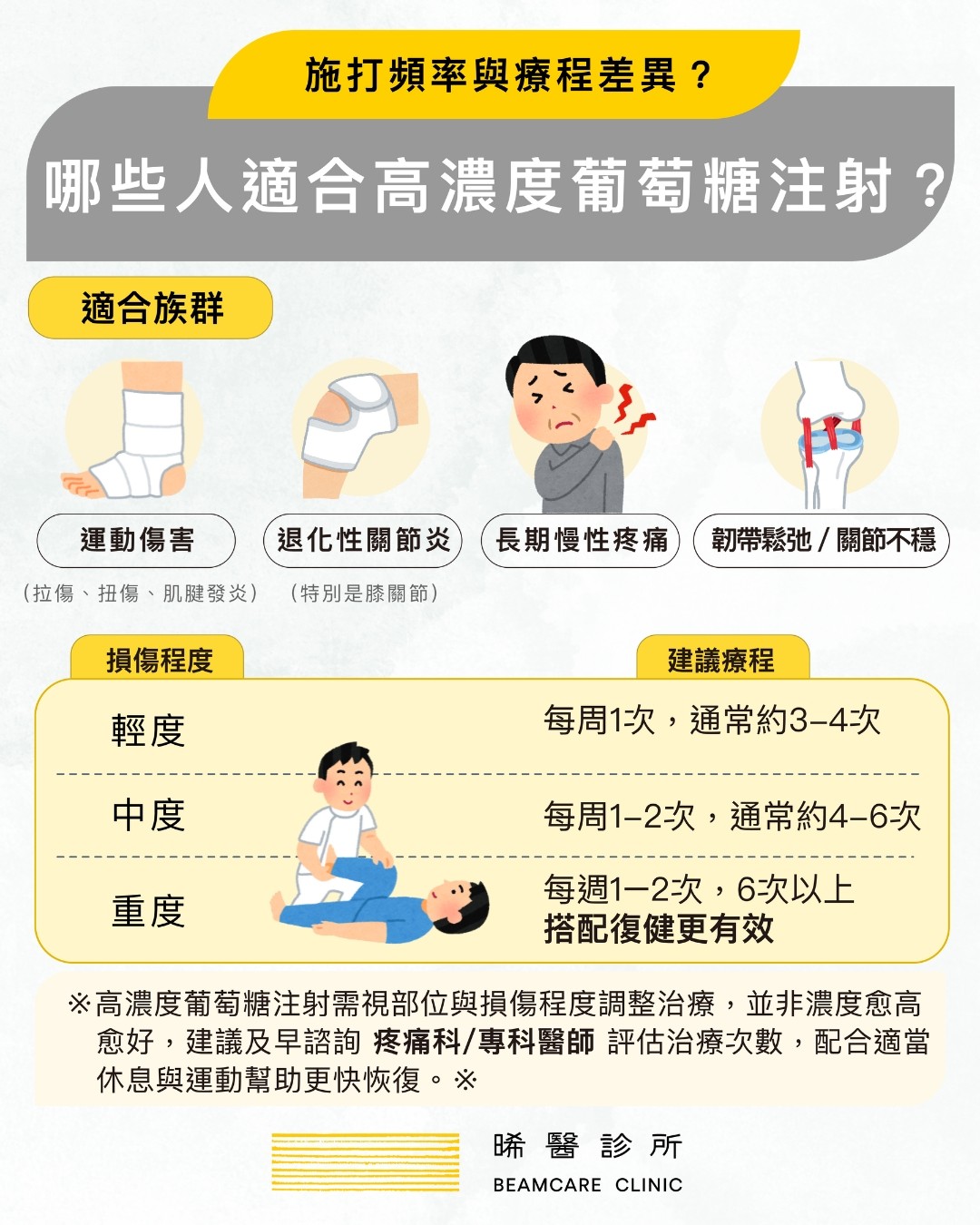
High-concentration glucose prolotherapy usually requires multiple treatment sessions to achieve the desired results, with injections given at intervals of about 2-6 weeks, depending on the recovery status. After treatment, excessive exercise should be avoided so as not to increase the burden on the injured area, and appropriate rehabilitation exercises should be performed according to the physician's recommendations. In addition, the frequency and number of treatments vary depending on the degree of injury or pain:
Minor injury or pain: About 3-4 injections, once a week, can lead to significant symptom improvement.
Moderate injury or chronic pain: Two sessions per week may require 4-6 injections, and as treatment progresses, soft tissue stability gradually recovers.
Severe injury or long-term chronic pain: More than 6 sessions may be needed, possibly combined with other rehabilitation treatments.
Each patient's condition is different, so the number and frequency of treatments should be determined after physician evaluation; do not judge this on your own. In addition, for severe injuries or long-term chronic pain, it is not recommended to combine treatment with a higher concentration of regenerative factors. Instead, lower concentrations should be injected multiple times to avoid an excessive inflammatory response in the affected area, which may worsen the condition.
3. Is there also a risk of injecting high-concentration glucose in the wrong place? Combining it with ultrasound guidance can improve treatment results
High-concentration glucose prolotherapy is mostly performed with a guided injection method to further ensure treatment accuracy, immediacy, and dynamic precision. Taking the knee, whose joint structure is relatively complex, as an example: if the injection is not administered into the tendon or ligament but instead into the fat pad, it may cause chronic inflammation in the affected area and make recovery even more difficult. Therefore, high-concentration glucose prolotherapy not only relies on ultrasound guidance to improve treatment outcomes, but the physician's own skill also plays a key role.
In addition to high-concentration glucose prolotherapy, low-concentration glucose tissue repair therapy provides the nutrients needed for tissue repair through isotonic sugar-containing fluids, improving the cell membranes of damaged fascia or nerves. Dr. Lu Bing-sheng believes that regardless of whether the glucose concentration is high or low, the two treatment courses each have their own therapeutic advantages and suitable candidates, and a physician should comprehensively evaluate and tailor the most appropriate treatment plan for the patient.
Although high-concentration glucose prolotherapy has the potential to promote tissue repair, it is not suitable for everyone. Before considering treatment, be sure to seek evaluation from a professional physician and provide detailed information about your medical history, medications, and allergies. After treatment, follow the physician's instructions, avoid excessive activity, and perform appropriate rehabilitation exercises to achieve the best treatment results.