
The efficacy of PRP is limited; can we evaluate the use of amniotic membrane extract instead?
The efficacy of PRP is limited; can we evaluate the use of amniotic membrane extract instead?
Article Summary
What is Amniotic Membrane Extract?
Amniotic membrane extract is derived from screened, donated placental amniotic and chorionic tissues, processed to preserve growth factors, cytokines, and extracellular matrix proteins. Injected into damaged tissue, the goal is to reduce inflammation and provide the signals needed for tissue repair.
The function of amniotic membrane extract is of the same category as PRP; both aim to aid tissue repair via injection, rather than surgical treatment or TAME catheter intervention. For the differences among these four treatments, please see "What is the Difference Between Amniotic Membrane and TAME?".
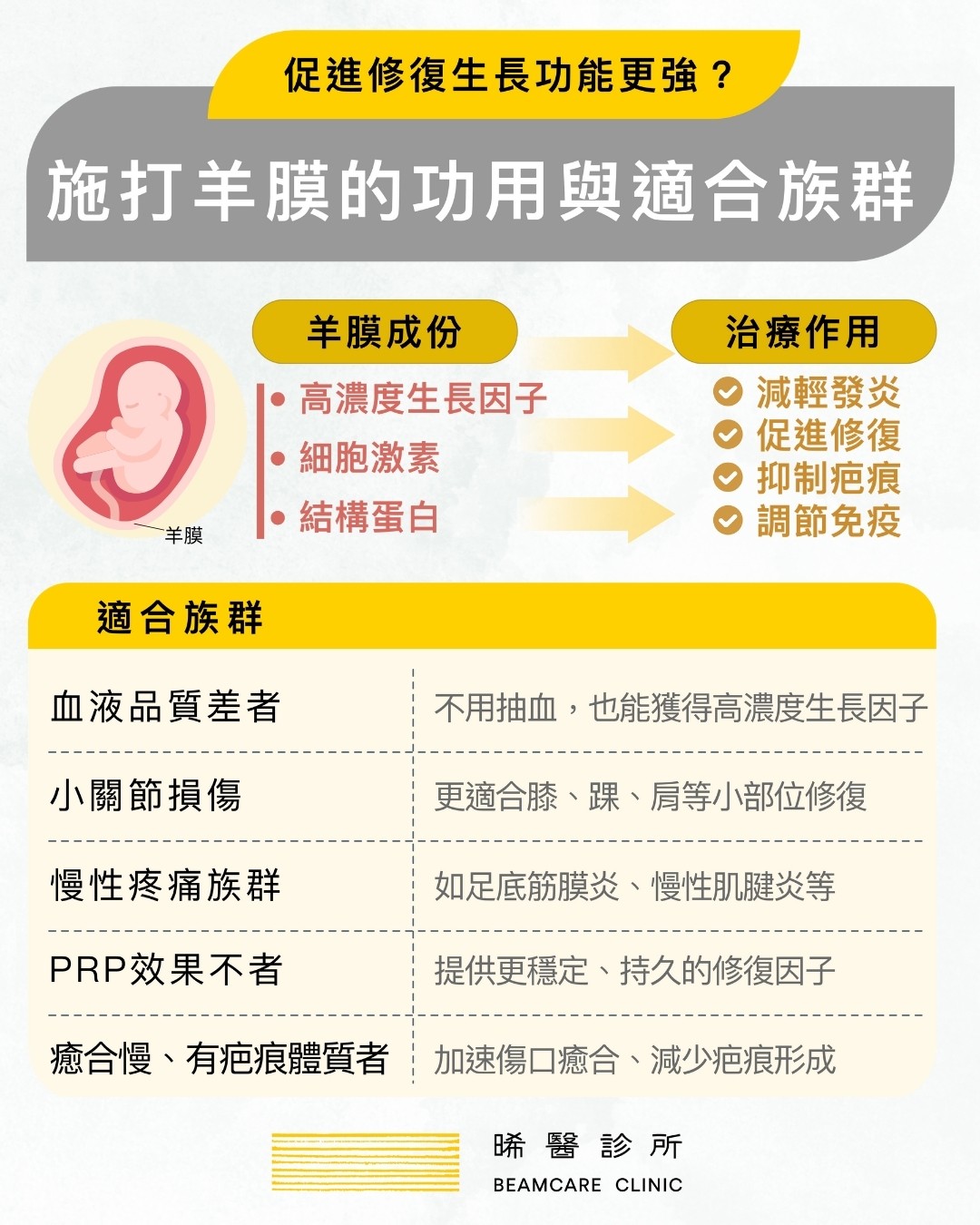
What is the Relationship Between Amniotic Membrane Extract and PRP?
There are two main differences.
The first difference is the source: PRP is derived from your own blood, from which platelet growth factors are isolated; amniotic membrane is of allogeneic origin and does not require blood drawing. The second difference is the preparation conditions: the quality of PRP is tied to your blood condition, and age or chronic diseases may affect the final quality; the components of amniotic membrane come from the preparation itself and are not affected by the quality of your own blood.
When the effect of PRP is limited, amniotic membrane is one of the options that can be evaluated for follow-up. Since their mechanisms and sources are different, it is not a case of one being an upgraded version of the other, and suitability must be evaluated by a physician.
Literature and Research on Amniotic Membrane
Knee Osteoarthritis: In a multi-center randomized controlled trial of 200 patients, the amniotic suspension injection group showed better improvement in pain and function at three and six months compared to the hyaluronic acid and saline control groups. Twelve-month extended follow-up showed that the improvement was sustained.
Plantar Fasciitis: In a randomized controlled trial of 145 patients, a micronized injectable formulation (belonging to the same dHACM product family as AmnioFix) was significantly superior to placebo in pain and functional outcomes at three months.

What Conditions Can Be Discussed and Evaluated with a Physician?
When blood drawing conditions are suboptimal, or blood quality is affected by age and chronic diseases, making PRP difficult to perform.
When PRP injections have yielded limited improvement and you want to know what other regenerative injection options are available.
Chronic tendon or fascia issues (such as plantar fasciitis), where you wish to discuss the next step after conservative treatment.
To consult on auxiliary methods for postoperative recovery status.
What Should I Pay Attention to Before Treatment?
If you have a history of allergies, be sure to inform your doctor before treatment. The source of the amniotic membrane used should be a qualified manufacturer and have obtained approval from the competent authorities; you can ask the clinic directly about this. Conditions such as immune system diseases, acute or chronic infections may render the treatment unsuitable, which the physician will verify during evaluation.
The source of the amniotic membrane used should be a product of a qualified manufacturer; Shixi Clinic uses AmnioFix (MiMedx, dehydrated human amnion/chorion membrane allograft).
How is the Treatment Scheduled? How Long Before Noticing Clear Results?
The amniotic membrane does not work with just one injection. Since everyone's physical condition, degree of injury, and repair capabilities differ, multiple injections are required in most cases. A common schedule is three to four sessions per course of treatment, spaced about two to six weeks apart, with the actual number of sessions and intervals evaluated by the physician. Sufficient sleep, proper diet, and moderate activity are crucial to ensure complete repair conditions.
Frequently Asked Questions
Is amniotic membrane more effective than PRP? They cannot be compared in this way. They have different sources, mechanisms, and literature study conditions, and individual differences are significant. Which one is suitable for you requires a physician to examine the cause of pain, imaging, and past treatment responses to establish a comprehensive treatment plan.
What is the difference between Amniotic Membrane and TAME? One is repair, and the other is blockage. Amniotic membrane is a repair material injection, while TAME uses catheter technology to embolize abnormally proliferating microvessels; the concepts and problems they address are different. For a complete comparison, please see "What is the Difference Between Amniotic Membrane and TAME?".
Do amniotic membrane injections require blood drawing? No, this is the most direct process difference between it and PRP. However, whether to receive the injection and where to inject it still requires a physician to evaluate the source of pain first.
If your pain has persisted for some time and past treatments have yielded limited results, you can first undergo a preliminary evaluation via LINE, and bring your past imaging data (X-rays, MRI) and treatment records during your visit. Shixi Clinic is located at 2F-1, No. 40, Sec. 2, Heping E. Rd., Da'an Dist., Taipei City, operating on a strictly reservation-only basis, Tel: (02) 2366-0186.
Author: Dr. Ping-Sheng Lu
Last Updated: August 21, 2026
Disclaimer: This article is for health education purposes only and cannot replace professional medical diagnosis and treatment advice. The suitability of any treatment should be determined after evaluation by a physician.
References: Farr J, Gomoll AH, Yanke AB, Strauss EJ, Mowry KC. A randomized controlled single-blind study demonstrating superiority of amniotic suspension allograft injection over hyaluronic acid and saline control for modification of knee osteoarthritis symptoms. J Knee Surg. 2019;32(11):1143-1154. PMID: 31533151 Gomoll AH, Farr J, Cole BJ, et al. Safety and efficacy of an amniotic suspension allograft injection over 12 months in a single-blinded, randomized controlled trial for symptomatic osteoarthritis of the knee. Arthroscopy. 2021;37(7):2246-2257. PMID: 33716121 Cazzell S, Stewart J, Agnew PS, et al. Randomized controlled trial of micronized dehydrated human amnion/chorion membrane (dHACM) injection compared to placebo for the treatment of plantar fasciitis. Foot Ankle Int. 2018. PMID: 30058377
