
What is TAME (Transarterial Microembolization)? Understand the principles, indications, and treatment process in one go
What is TAME (Transarterial Microembolization)? Understand the principles, indications, and treatment process in one go
Article Summary
You have tried anti-inflammatory medications, physical therapy, shockwave therapy, pain patches, and local injections, yet the pain keeps recurring. Many people ask: what on earth hasn't been addressed? This article is a comprehensive guide to TAME (Transcatheter Arterial Micro-Embolization). First, we will explain the most important key points, and then clarify the mechanism, suitability, procedure, risks, and evidence section by section.
First, Key Points of TAME
TAME (Transcatheter Arterial Micro-Embolization) does not treat joint wear and tear; rather, it treats abnormally proliferating microvessels in chronically inflamed tissues, as well as the sensory nerve endings that grow along with these vessels. The treatment involves entering through an artery in the wrist or groin to deliver an embolic agent to the target area, reducing blood flow to those abnormal blood vessels.
It is suitable for individuals whose response to conservative treatment is limited and whose pain has persisted for more than six months; it is not a first-line treatment. The entire procedure is performed under local anesthesia while the patient is awake. It does not require general anesthesia, nor does it require hospitalization—it is an outpatient procedure.
The "Transcatheter" in TAME's full name refers to a catheter-based treatment. The original method developed by Dr. Yuji Okuno is a catheter-based therapy performed under angiography guidance using a microcatheter, which is C-TAME (standard type). The later-developed s-TAME is a simplified version, performed under ultrasound guidance in shallower areas without inserting a catheter. Both target abnormal blood vessels, but they apply to different depths of target sites, which are determined by the physician based on imaging.
Healer Clinic performs catheter-based C-TAME using the GE OEC 3D mobile C-arm equipped with cone-beam CT (3D tomography). The procedure is performed by Director Dr. Ping-Sheng Lu, who holds the Taiwan trademark authorization from Okuno Clinic.
Why Won't Chronic Pain Go Away?
Because the source of pain may not just be inflammation. After muscles, tendons, and joints are injured, repeatedly strained, or degenerated, in addition to local inflammatory responses, abnormally proliferating microvessels may grow in the area. These blood vessels are accompanied by unmyelinated nerve endings that continuously release "I am injured" signals.
Conservative treatments like anti-inflammatory drugs and patches address inflammatory responses, while physical therapy addresses mobility and muscle strength. However, these methods can hardly act directly on the already formed abnormal blood vessels and nerve structures, which is one of the reasons why some chronic pain recurs repeatedly and treatments become increasingly limited in effectiveness.
What is the Principle of TAME?
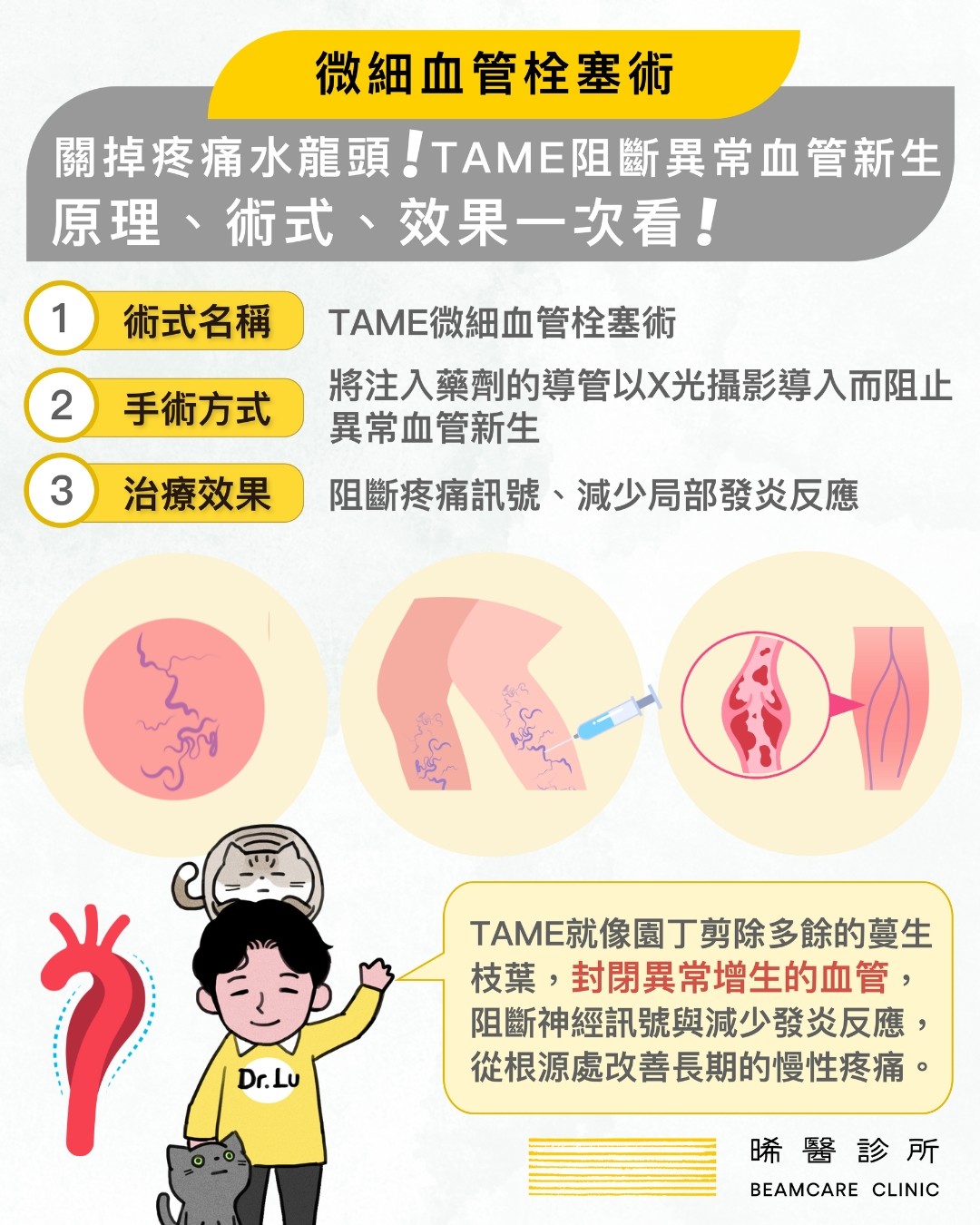
TAME is a minimally invasive interventional treatment administered via transarterial injection, also known as musculoskeletal embolization or neovascular clearance. The principle is to deliver embolic medication to abnormally proliferating microvessels, causing these vessels to shrink, with the goal of reducing the source of pain signals and alleviating persistent local inflammation.
We can imagine it this way: abnormal blood vessels and nerve endings are like a source continuously sending out pain signals. What TAME does is address this source itself, rather than trying to suppress the signals after they have already been sent out. This is also how it differs from anti-inflammatory drugs and physical therapy in the links they target; the three do not replace each other.
Does "Pruning" Abnormal Blood Vessels Affect Normal Ones?
The concept of the treatment is to address only the abnormal parts.
The standard C-TAME is performed under the guidance of angiography equipment: the physician uses a microcatheter to identify abnormally proliferating blood vessels on the image and selectively delivers the embolic drug to the target area. This concept is similar to a gardener pruning a tree, cutting away only the cluttered, redundant branches while preserving the healthy main trunk. After the abnormal blood vessels shrink, the pain signals and local inflammatory responses they release are subsequently reduced, while normal blood vessels are preserved.
At Healer Clinic, C-TAME utilizes the GE OEC 3D mobile C-arm with cone-beam CT (3D tomography) capability to obtain three-dimensional images of microvessels during the procedure for selective embolization, performed by Director Dr. Ping-Sheng Lu.

What Situations are Suitable for TAME Evaluation?
Three conditions must be met together; meeting just one is not enough.
The pain has persisted or recurred for more than six months; conservative treatments such as anti-inflammatory drugs, physical therapy, shockwave therapy, patches, or local injections have been tried with limited effect; and the severity of the pain has affected sleep, work, or exercise. Only when all three conditions are met will we proceed to an evaluation.
Common areas evaluated include the fingers, toes, wrists, ankles, knees, elbows, shoulders, and hips. Examples include frozen shoulder, partial rotator cuff tears, tennis elbow, golfer's elbow, degenerative knee osteoarthritis, plantar fasciitis, and long-term pain caused by post-surgery, large-scale injuries, or strain and degeneration.
For three of the most common areas, we have individual articles explaining how to proceed with evaluation when conservative treatment response is limited: for shoulders, please see "What to Do If Frozen Shoulder Physical Therapy Just Won't Heal?"; for elbows, please see "Tennis Elbow Physical Therapy Done But Still Won't Heal?"; for knees, please see "Knee PRP or Hyaluronic Acid Injections Still Painful?".
Different areas require different pathways, which are determined by the physician based on imaging. It is important to note that TAME has specific indications and is not suitable for all chronic pain.
What Situations are Not Suitable, or Require Other Problems to Be Addressed First?
This section is more important than the previous one, because it determines whether you might make a trip in vain.
If the pain is still in the acute stage, or the disease course is less than six months, conservative treatment is usually tried first. If imaging shows structural problems that need surgical intervention (significant nerve compression, large-scale tears, severe joint deformity), those structural issues must be resolved first. If the source of the pain has not been identified, the first step is diagnosis, not treatment. For this section, please see "Pain Persists After Six Months of Physical Therapy, but the Doctor Says No Surgery is Needed?".
Additionally, let's clear up a common misunderstanding: numbness and weakness are not indications for TAME. Numbness and weakness caused by nerve compression require nerve examinations and decompression, which are completely different issues from vascular proliferation.
Individuals with bleeding tendencies, those currently taking anticoagulant medications, those allergic to contrast media, those with active infections, or those with poor kidney function need to be evaluated by a physician first. For the complete list of four groups requiring cautious evaluation, please see "Who is Not Suitable for TAME Microcatheter Arterial Embolization?".
How is the Treatment Administered on the Day?
The process is roughly as follows.
Before the treatment, the evaluation results and medications will be confirmed, and instructions on which medications need to be stopped will be provided in advance. On the day of the procedure, under local anesthesia, a puncture of about 2 mm is made at the wrist (radial artery) or the groin (femoral artery).
Under image guidance, a microcatheter is delivered to the feeding artery of the target area. After confirming the position, the embolic agent is injected to reduce blood flow to the abnormal vessels. The patient remains awake during the process and can communicate with the physician.
The treatment itself usually takes one to two hours, followed by observation in the clinic. Pressure is applied to the puncture site to stop bleeding, and the patient returns home the same day. No hospitalization is required.
What are the Risks and Limitations?
Let's first talk about limitations: TAME does not address structural problems. If a joint is already severely deformed or ligaments are extensively torn, these issues cannot be resolved by reducing blood flow; if surgery is needed, surgery should still be performed.
Regarding risks, there may be bruising, pain, or hematoma at the puncture site; the treated area may experience soreness or swelling for a few days after the procedure; if the embolic agent enters blood vessels outside the target area, it may cause local skin changes, and in rare cases, there is a risk of tissue ischemia. This is also why the precision of image guidance and operational experience affect safety. Allergic reactions and kidney burden associated with contrast media require prior evaluation.
The effectiveness varies from person to person, and there are cases where patients undergo treatment after evaluation but show limited improvement. Any claim that it is "guaranteed to be effective" is unfounded.
How Long is the Recovery Period?
The puncture site usually heals within a few days. Most daily activities can be resumed on the same day or the next day, while strenuous exercise and weight training should be cleared with your physician.
The response time of the treated area varies from person to person: some people feel changes within a few weeks, while others need longer. This is not a matter of fast or slow progress, but rather depends on each individual's tissue status, which needs to be followed up and evaluated by the physician.
Where Does the Current Evidence Stand?
To be honest: this is a relatively new treatment, and evidence is still accumulating.
Dr. Yuji Okuno's team has published clinical reports on knee joints, shoulders, and elbows since 2014, showing that some patients for whom conservative treatment failed experienced pain reduction after treatment. Western research mainly focuses on Genicular Artery Embolization (GAE), among which a controlled trial in 2022 supported its efficacy, while a study in 2024 yielded negative results. The Society of Interventional Radiology's 2026 clinical guidelines position this type of treatment as an option that can be considered under specific conditions.
This means: it has a clinical foundation, but it is not applicable to all situations, nor has it reached the status of "standard treatment." This is something you should know before making your decision.
TAME Has Two Pathways: Standard Type and Simplified Type
The catheter-based C-TAME is the original standard method, performed under angiography guidance using a microcatheter for selective embolization, which can handle deeper lesions with more complex vascular pathways. s-TAME is a simplified version developed later, performed under ultrasound guidance in shallower areas.
The two divide the work based on the depth of the site, and the actual type suitable for you will be evaluated and determined by the physician based on imaging. Some clinics in the market only offer one of them, so it is worth asking clearly before evaluation. For a complete comparison, including their respective suitable sites, equipment requirements, and selection criteria, please see "What is the Difference Between C-TAME and s-TAME?".
Frequently Asked Questions
Will the pain be completely gone after the procedure? Not necessarily. The effectiveness varies by individual and area, and there are cases with limited improvement. A reasonable expectation is a decrease in pain level and its impact on daily life, not a guaranteed disappearance.
Is it covered by National Health Insurance? Currently, it is a self-pay item. The cost varies depending on the site and the treatment area, which will be explained after evaluation.
Can I undergo the procedure if I have numbness and weakness? No. These two symptoms fall under the pathway of neurological examination; please confirm the cause first.
For other frequently asked questions (cost details, whether physical therapy is needed, whether it will recur, whether it can be done after PRP injections, how to handle anticoagulants), please see "TAME Transcatheter Arterial Micro-Embolization FAQ".
Where Can I Learn More?
To understand the difference between TAME and long-term steroid pain relief, please see "What is the Difference Between TAME Micro-Embolization and Long-Term Steroid Pain Relief?"; for overall treatment options and sequence, please see "What are the Treatment Options for Chronic Pain?".
Written by: Dr. Ping-Sheng Lu
Last Updated: September 2, 2026
Disclaimer: This article is for health education information purposes and cannot replace professional medical diagnosis and treatment advice. The suitability of any treatment must be evaluated and decided by a physician.
Yuji Okuno Micro-Embolization Reference Literature:
Okuno Y, Korchi AM, Shinjo T, et al. Midterm clinical outcomes and MR imaging changes after transcatheter arterial embolization as a treatment for mild to moderate radiographic knee osteoarthritis resistant to conservative treatment. J Vasc Interv Radiol. 2017;28(7):995-1002. doi:10.1016/j.jvir.2017.02.033
