
How to choose a treatment for benign prostatic hyperplasia (BPH)? A complete comparison of PAE embolization, TURP (electric resection), laser therapy, Rezūm (water vapor), AquaBeam (aquablation), and UroLift (prostatic urethral lift)
How to choose a treatment for benign prostatic hyperplasia (BPH)? A complete comparison of PAE embolization, TURP (electric resection), laser therapy, Rezūm (water vapor), AquaBeam (aquablation), and UroLift (prostatic urethral lift)
Article Summary
When medication is limited in its effectiveness for benign prostatic hyperplasia (BPH), traditional transurethral resection of the prostate (TURP) is no longer the only treatment option. Current approaches can be divided into two paths: transurethral surgeries (TURP, laser, water vapor thermal therapy, waterjet ablation, and prostatic urethral lift), and prostatic artery embolization (PAE), which is performed through the arteries without entering the urethra. The differences among these six treatment methods lie not in which is newer or older, but in their access routes, anesthesia requirements, recovery processes, and suitable patient groups.
This article compares the six methods in detail to help you understand your options before discussing them with your physician.
What are the treatments for benign prostatic hyperplasia? Understand the two paths first: Transurethral vs. Transarterial
If medication is of limited effectiveness, the current mainstream treatment methods can be categorized into two main types.
The first type enters through the urethra to directly treat prostate tissue. This includes transurethral resection of the prostate (TURP), laser vaporization or enucleation, water vapor thermal therapy, waterjet ablation, and prostatic urethral lift. Although they use different energy sources and mechanisms, they all share the commonality of passing instruments through the urethra.
The second type enters through the blood vessels. The physician inserts a catheter through an artery in the groin or wrist to selectively embolize the arteries supplying the prostate, thereby reducing the volume of the gland. The entire process does not involve the urethra, does not remove tissue, and does not touch the lower half of the body.
The official name of this treatment is prostatic artery embolization, abbreviated internationally as PAE.
To learn more about the process and suitability of this path, please see "Is Surgery Necessary for Benign Prostatic Hyperplasia? A Patient Guide to PAE".
There is no absolute better or worse option between the two paths. The right treatment for you depends on your prostate volume, symptom profile, anesthetic risk, and your personal priorities: whether it will affect sexual function, whether you will need a catheter after surgery, whether you can avoid hospitalization, and how long recovery will take.
The comparison table below outlines the access route, anesthesia, hospitalization, and suitable patient groups for all six methods side-by-side. The actual choice should be evaluated by a urologist or interventional radiologist based on examination results.
When should treatments other than medication be considered for benign prostatic hyperplasia?
There are three common scenarios: when urinary symptoms (such as frequent urination, nocturia, weak urine stream, or incomplete emptying) still significantly affect your quality of life after a period of drug therapy; when you cannot tolerate the side effects of medications (such as dizziness, orthostatic hypotension, or decreased libido); or when complications such as urinary retention, recurrent urinary tract infections, or bladder stones have already occurred. At this stage, it is worthwhile to understand the differences among the various treatment options and make a choice based on your physical condition and personal preferences.
For patients who have undergone drug therapy but still experience limited symptom control, PAE has been directly compared to drug therapy in randomized studies: the 2023 PARTEM multicenter Phase III trial showed that among the enrolled patients, PAE provided superior symptom relief compared to combination medical therapy with dutasteride and tamsulosin.
The Fundamental Difference Among the Six Treatments: Route of Entry
Transurethral Route: TURP, laser, water vapor thermal therapy, waterjet ablation, and prostatic urethral lift are all performed by urologists who enter transurethrally using an endoscope to directly treat prostate tissue. The difference lies in the method used (electric loop, laser light, water vapor, high-pressure waterjet, or implants to bind the enlarged prostate and hold the channel open).
Transarterial Route: PAE does not go through the urethra. The physician inserts a microcatheter through an artery in the wrist or groin. Guided by angiography, they selectively embolize the arteries supplying the prostate, causing the gland to naturally become ischemic, shrink in volume, and reduce compression on the urethra.
This difference determines several things: Because PAE does not enter through the urethra and does not directly remove prostate tissue, it serves as a different option for those who are concerned about instruments entering the urethra, do not want a post-operative urinary catheter, or are concerned about retrograde ejaculation and erectile dysfunction. On the other hand, PAE requires angiography equipment and interventional expertise, and symptom improvement occurs gradually as the gland shrinks, rather than immediately after the procedure.
A Complete Comparison of the Six Procedures
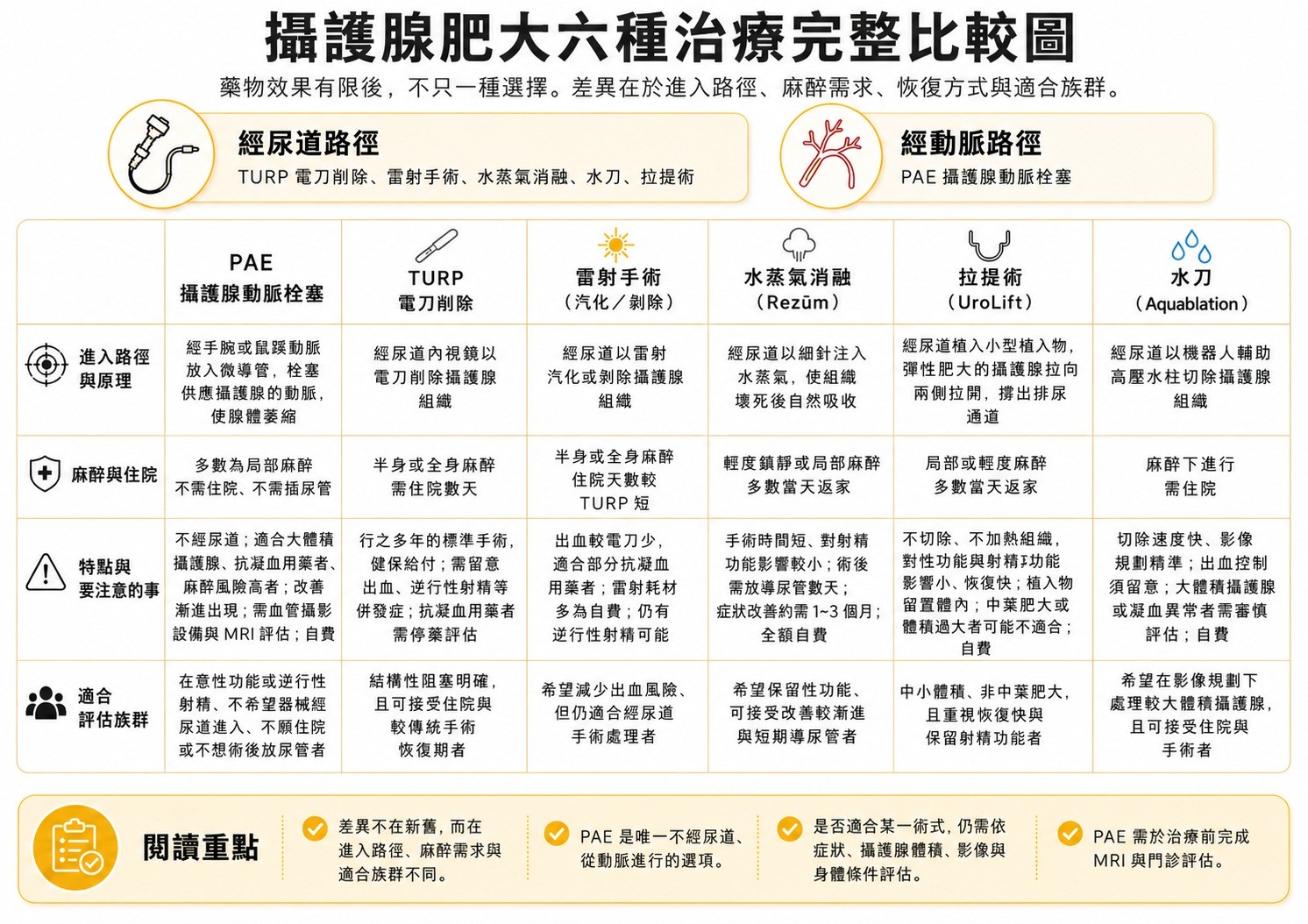
PAE (Prostatic Artery Embolization)
Access Route and Principle: A microcatheter is inserted through the wrist or groin artery to embolize the arteries supplying the prostate, causing the gland to shrink.
Anesthesia and Hospitalization: Mostly local anesthesia; no hospitalization required, no urinary catheter needed.
Features and Considerations: Does not go through the urethra; suitable for large prostate volumes, patients taking anticoagulants, and those with high anesthetic risks; improvement is gradual; requires angiography equipment and MRI evaluation; primarily self-pay.
TURP (Transurethral Resection of the Prostate)
Access Route and Principle: An endoscope is passed through the urethra to shave away prostate tissue using an electric loop.
Anesthesia and Hospitalization: Spinal or general anesthesia; requires several days of hospitalization.
Features and Considerations: A standard surgery with years of clinical history, covered by National Health Insurance; potential complications such as bleeding, retrograde ejaculation, and urinary leakage need to be considered; patients taking anticoagulants must bear the risks of stopping their medication.
Laser Surgery (Vaporization/Enucleation)
Access Route and Principle: Laser energy is delivered through the urethra to vaporize or enucleate prostate tissue.
Anesthesia and Hospitalization: Spinal or general anesthesia; shorter hospital stay compared to TURP.
Features and Considerations: Less bleeding than TURP, suitable for some patients on anticoagulant medications; laser consumables are mostly self-pay; retrograde ejaculation is still possible.
Water Vapor Thermal Therapy (Rezūm)
Access Route and Principle: High-temperature water vapor is injected through the urethra using a fine needle, causing tissue necrosis which is then absorbed by the body.
Anesthesia and Hospitalization: Mild sedation or local anesthesia; most patients return home the same day.
Features and Considerations: Short procedure time, minimal impact on ejaculatory function; requires a urinary catheter for a few days after the procedure, and symptom improvement takes about one to three months; fully self-pay.
Prostatic Urethral Lift (UroLift)
Access Route and Principle: Small implants are delivered through the urethra to bind the enlarged prostate and pull it to both sides, holding the urinary channel open.
Anesthesia and Hospitalization: Local or mild anesthesia; most patients return home the same day.
Features and Considerations: No tissue cutting or heating, minimal impact on sexual and ejaculatory functions, fast recovery; implants remain in the body; may not be suitable for patients with median lobe hyperplasia or excessively large prostate volumes; structural deformation after lifting makes post-operative MRI evaluation and follow-up difficult; self-pay.
Waterjet Ablation (Aquablation)
Access Route and Principle: High-pressure waterjet ablation of prostate tissue is performed transurethrally with robotic assistance.
Anesthesia and Hospitalization: Performed under anesthesia; requires hospitalization.
Features and Considerations: Fast resection speed, precise imaging planning; bleeding control requires careful attention, and careful evaluation is needed for patients with large prostate volumes or coagulation abnormalities; self-pay.
Who is PAE suitable for? Who is it not suitable for?
Groups suitable for PAE evaluation: Patients whose prostate volume is too large for surgery as evaluated by a urologist, or who face high risks with traditional surgery; those currently taking anticoagulant medications or with abnormal coagulation function; elderly patients or those with high anesthetic risks who are unsuitable for general anesthesia; those who care about sexual function and worry about retrograde ejaculation; those who do not want instruments entering through the urethra, or who wish to avoid hospitalization and post-operative urinary catheters.
Cases that are unsuitable or require cautious evaluation: Poor vascular conditions (severe atherosclerosis and tortuous arteries, making it difficult for the catheter to reach the target), cases where the primary cause of symptoms is not prostate enlargement (such as bladder function issues), and acute infection phases. Suitability must be determined by a physician after evaluating prostate volume and vascular conditions using MRI imaging.
How is PAE performed at Sunrise Clinic?
PAE at Sunrise Clinic is performed in our in-house angiography suite using a GE OEC 3D mobile C-arm with cone-beam CT functionality. A 3D imaging system must be utilized during the procedure to confirm the location of the micro-prostatic arteries for selective embolization, thereby reducing the chance of affecting neighboring blood vessels. In most cases, local anesthesia is used, and the procedure is performed through the wrist artery. The wound is about the size of a pinhole, and the minimally invasive procedure takes about one to two hours. Follow-up is conducted in the outpatient clinic, and no hospitalization is required.
MRI and outpatient evaluations must be completed before treatment. Symptom improvement appears gradually as the gland shrinks, typically becoming progressively noticeable between a few weeks to several months after treatment. The physician will fully explain the expected timeline before the procedure.
Frequently Asked Questions
Q: Which is more effective, PAE or TURP?
Both PAE and TURP can improve urinary symptoms caused by benign prostatic hyperplasia, but they offer different advantages. Randomized controlled trials and 5-year follow-ups show that TURP generally provides more pronounced improvements in objective urinary indicators such as urine flow rate and post-void residual volume. The advantages of PAE are that it does not go through the urethra, is minimally invasive, and offers a faster recovery. Long-term follow-up also indicates that the likelihood of requiring retreatment after PAE is higher than after TURP. Which one is suitable requires a comprehensive evaluation by both a urologist and an interventional radiologist, considering symptom severity, prostate size and morphology, anesthetic risk, vascular conditions, and your personal treatment preferences.
Q: Can TURP still be performed after PAE?
Yes. PAE does not alter the structure of the urethra or the prostate. If surgery is still required in the future, it will not affect subsequent options.
Q: Water vapor thermal therapy claims to preserve most sexual function; how does it differ from PAE?
The route is different: Water vapor thermal therapy still enters through the urethra and uses thermal energy to cause tissue necrosis and shrinkage, requiring a urinary catheter for several days post-procedure, with symptom improvement taking about one to three months. PAE is performed through the arteries, does not enter the urethra, and its improvement is also gradual. Both are self-pay treatments with different suitability criteria, requiring professional evaluation.
Q: How do I choose between Prostatic Urethral Lift (UroLift) and PAE?
Both aim to reduce the impact of treatment on sexual function, but their mechanisms of action are different. Prostatic urethral lift involves placing small implants transurethrally to pull and secure the obstructing prostate tissue to both sides. It does not remove tissue, nor does it shrink the prostate, and symptom improvement usually occurs faster.
PAE, on the other hand, reduces the blood supply to the prostate from the arterial end, causing the enlarged gland to shrink gradually. It does not go through the urethra and involves no permanent implants, and larger prostate volumes can also be considered for evaluation.
The choice between the two treatments still requires a comprehensive evaluation by a physician, taking into account prostate volume, lateral or median lobe morphology, the degree of obstruction, vascular conditions, and the patient's preferences regarding implants and recovery time.
Q: Is PAE covered by National Health Insurance?
PAE is a self-pay treatment. The cost depends on the evaluation and treatment plan, which will be fully explained during your outpatient consultation.
Q: Where can I get evaluated for PAE in Taipei?
Sunrise Clinic is located on the 2nd Floor-1, No. 40, Section 2, Heping East Road, Da'an District, Taipei City. We have specialized clinics for male function and cardiovascular health (NT$1,500 for initial consultation, NT$800 for follow-up consultations). Visits are by appointment only. You can schedule an evaluation via LINE or by calling (02) 2366-0186.
Author: Dr. Chun-Yu Lin
Last Updated: August 16, 2026
Disclaimer: This article is for educational purposes only and cannot replace professional medical diagnosis and treatment advice. The suitability of any treatment must be evaluated and decided by a physician.
Prostatic Artery Embolization (PAE) International Literature References:
Abt D, Hechelhammer L, Müllhaupt G, et al. Comparison of prostatic artery embolisation (PAE) versus transurethral resection of the prostate (TURP) for benign prostatic hyperplasia: randomised, open-label, non-inferiority trial. BMJ. 2018;361:k2338. doi:10.1136/bmj.k2338
Müllhaupt G, Hechelhammer L, Diener PA, et al. Prostatic artery embolisation versus transurethral resection of the prostate for benign prostatic obstruction: 5-year outcomes of a randomised trial. Eur Urol Focus. 2024;10(5):788-795.
Sapoval M, Thiounn N, Descazeaud A, et al. Prostatic artery embolisation versus medical treatment in patients with benign prostatic hyperplasia (PARTEM): a randomised, multicentre, open-label, phase 3 superiority trial. Lancet Reg Health Eur. 2023;31:100672. doi:10.1016/j.lanepe.2023.100672
