
Still in pain after PRP or hyaluronic acid knee injections? Reasons for ineffective treatment and a comprehensive decision guide for your next steps
Still in pain after PRP or hyaluronic acid knee injections? Reasons for ineffective treatment and a comprehensive decision guide for your next steps
Article Summary
If you still feel pain after receiving PRP or hyaluronic acid injections in your knee, the most common reason is not treatment failure, but rather that the treatment target did not match the source of the pain. The next step when injection therapy is ineffective is not to rush to change to another type of injection, but to go back and reconfirm: what exactly is the source of the pain.
This article will explain the reasons why injection therapy may not be effective, what key points doctors will check during reassessment, and the situations for which rehabilitation, injections, catheter-based C-TAME, and surgery are respectively suited, helping you understand the positioning of different treatment options and find a more appropriate next step.
If PRP or hyaluronic acid injections are ineffective, does it mean the knee is beyond hope?
It does not mean it is beyond hope.
PRP and hyaluronic acid each have clear targets: hyaluronic acid mainly improves lubrication in the joint cavity, while PRP uses growth factors to promote tissue repair. If the primary source of pain is not within their scope of action—for example, if the pain has become chronic and is accompanied by abnormally proliferating microvessels and nerves—then even with multiple injections, the effect will be limited.
An ineffective treatment is an important diagnostic clue: it suggests that the originally assumed source of pain may need to be corrected, rather than declaring that there is no way forward.
Every treatment has its appropriate timing, and each corresponds to different causes of pain
Rehabilitation is the first step for most people, with a focus on improving muscle strength and load; hyaluronic acid improves joint lubrication, and PRP and amniotic membrane preparations primarily aim for tissue repair. If the pain has become chronic and is mainly related to abnormal microvessels, simple repair or lubrication therapy may not address the true cause. Catheter-based C-TAME targets this type of pain mechanism; if there is clear structural damage, surgery will then be further evaluated.
The key to choosing which treatment is not to compare which is better, but to find the true source of the pain.
Why are injection treatments ineffective? Three common reasons
The source of pain is not within the scope of action of the injection
Many people think that knee pain means cartilage wear and tear, but in reality, the source of pain can come from different tissues, such as ligaments, tendon insertion points, bursae, fat pads, or even referred pain caused by the hip or lumbar spine. Even if the injection is placed correctly, if the site actually causing the pain is not the target of the treatment, the improvement may still be limited.
2. The pain has become chronic
When pain persists for more than several months, a pain mechanism different from acute inflammation may gradually form at the painful site, such as abnormally proliferating microvessels and accompanying nerve proliferation. At this point, the reason the pain persists is no longer just tissue injury or inflammation, so injection treatments aimed at lubrication or tissue repair may not address the true source of pain.
3. The load issue has not been resolved
Body weight, movement patterns, and insufficient muscle strength can all subject joints to long-term, repetitive irritation. Injection treatments can improve local pain or inflammatory responses, but if the source of the load causing the problem is not adjusted, the pain may still reappear after some time.
What needs to be checked during reassessment?
The purpose of reassessment is not to rush to change to the next treatment, but to reconfirm the cause and mechanism of the current pain.
At the initial visit of the Pain Special Clinic of Hsi-Yi Clinic, a comprehensive assessment is conducted, including detailed inquiry into the pain location, time of onset, and triggering actions. Combined with physical examinations, the doctor determines whether the pain comes from the joint itself, surrounding soft tissues, or referred pain from other areas. High-end imaging ultrasound and X-ray examinations are then arranged as needed to help find the appropriate target for treatment.
It is important to note that changes seen on imaging examinations are not necessarily the cause of the pain. Some people have normal imaging results but may still have problems causing pain; some may show signs of degeneration, but these are not necessarily the source of the pain. Doctors need to comprehensively evaluate imaging results together with symptoms and physical examinations to find the location that truly needs to be addressed.
How to choose between rehabilitation, injections, C-TAME, and surgery? A decision-making table
Different treatment modalities address different problems. There is no simple "which one is better," and the choice of treatment should be determined based on the source of pain, the stage of the disease, and response to past treatments.
The logic of the decision table below is a treatment ladder, not a ranking of effectiveness.
Most knee pain starts with conservative treatments, such as activity modification, rehabilitation training, medication, or injection therapy. These methods can help improve muscle strength, reduce joint load, or target inflammation and repair issues in specific tissues.
However, if appropriate conservative treatment has been completed, or even after receiving injection therapy, the pain still persists or recurs repeatedly, the current pain mechanism needs to be re-examined. At this time, the focus is not just "changing to another treatment," but confirming whether the pain has entered a chronic stage, or whether there are structural problems that need to be addressed in other ways.
Therefore, rehabilitation, injections, catheter-based C-TAME, and surgery are not mutually exclusive options, but rather correspond to different problems under different circumstances. Which method is suitable still needs to be determined by the physician through inquiry, physical examination, and imaging evaluation, confirming the cause of pain before formulating a suitable treatment direction.
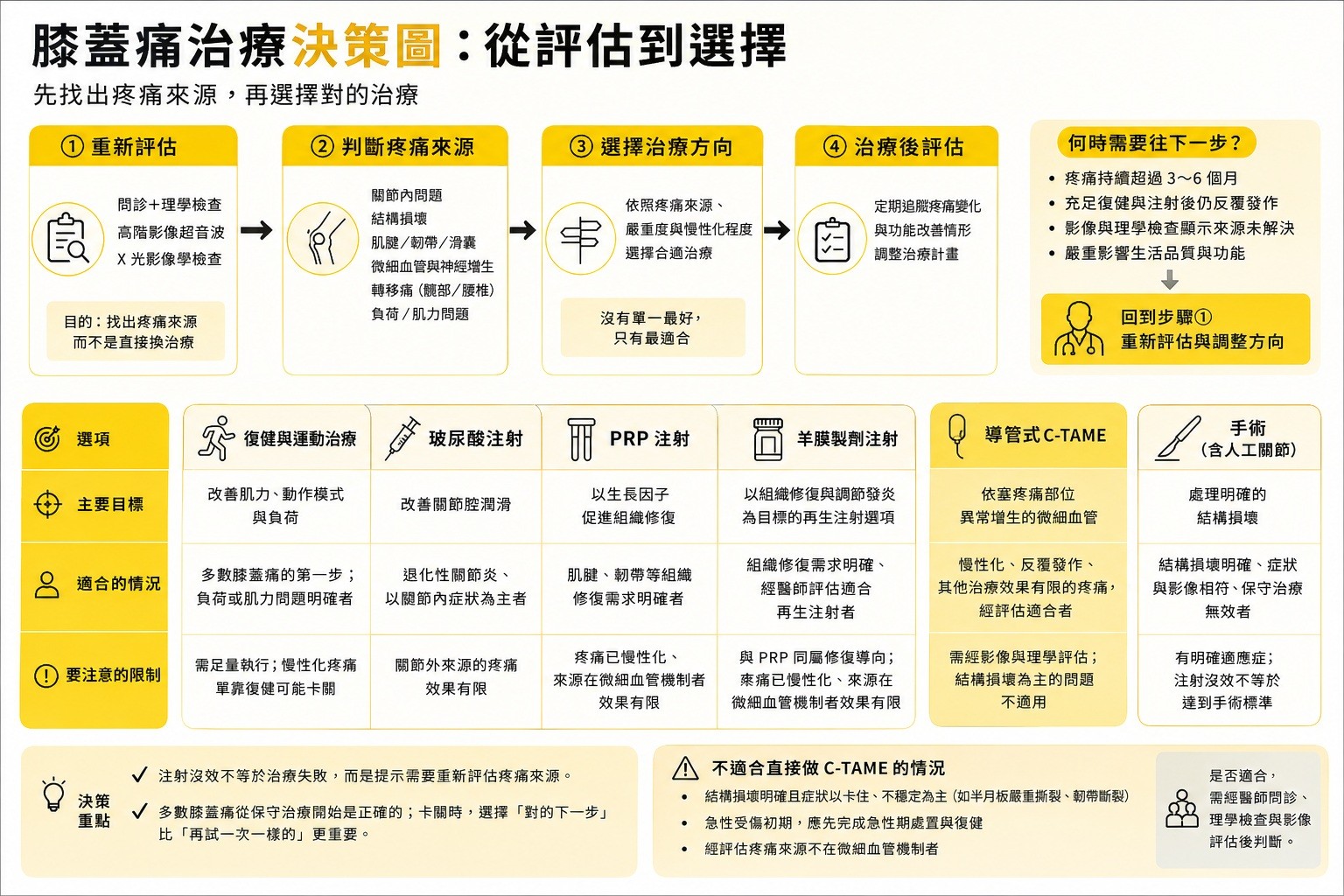
What situations are suitable for evaluating C-TAME? What situations are not?
Generally speaking, if knee pain persists for more than three to six months, recurs repeatedly after rehabilitation or injection therapy, and is suspected to be related to chronic, abnormal microvessels through inquiry, physical examination, and imaging evaluation, the doctor may further evaluate whether the patient is suitable for C-TAME.
However, not all pain is suitable for C-TAME. If the pain mainly comes from clear structural damage, such as a severe meniscus tear or a ruptured ligament, and presents primarily with symptoms like joint locking or instability, these types of problems are not within the primary scope of embolization.
In addition, in the early stages of acute injury, acute management and rehabilitation should usually be completed first. If evaluation confirms that the cause of pain does not come from mechanisms related to abnormal microvessels, C-TAME will not be recommended.
Therefore, whether C-TAME is suitable still requires a comprehensive judgment by a physician through detailed inquiry, physical examination, and imaging evaluation.
The treatment principle of Hsi-Yi Clinic is to first identify the cause of pain, and then choose the appropriate treatment tool. Some patients are suitable for C-TAME, and some, after evaluation, are found not to need C-TAME at present, but should prioritize other issues instead. Finding the direction that suits you is more important than choosing a specific treatment.
What can you do as a next step?
For the complete treatment sequence and how the various stages connect, please see "What are the treatment choices for chronic pain?".
Frequently Asked Questions
Q: PRP has been injected two or three times without effect, should I keep getting them?
When the same treatment is repeatedly ineffective, a reasonable next step is to reassess the source of pain, rather than continuing to accumulate the number of treatments. Please bring your previous treatment records, which will help the doctor make a judgment.
Q: Injections are ineffective, can I just switch directly to an artificial joint?
Not necessarily. Joint replacement has clear indications; ineffective injections do not equal meeting the criteria for joint replacement. In between the two, there are treatment options targeting the mechanisms of chronic pain, which can be decided after evaluation.
Q: How to choose between C-TAME and another PRP injection?
The goals of the two are different: PRP targets tissue repair, while C-TAME targets abnormal microvessels at the site of chronic pain. Which one to choose depends on the source of pain identified by assessment, not on the price or how new the technology is.
Q: What if I am not suitable for C-TAME after evaluation?
The doctor will explain the reasons and recommend a suitable treatment direction, which may be adjusting rehabilitation strategies, managing the source of the load, or referring to an appropriate specialty. The purpose of the assessment is to find the right direction, not to lead to a specific treatment.
Q: What should I prepare for the initial visit?
Previous examination imaging (X-ray, MRI discs or reports), treatment records (what injections you have had, what rehabilitation you have done), and current medications. The initial visit fee for the Pain Special Clinic is 3,000 NTD, which includes consultation, physical examination, high-end imaging ultrasound, and X-ray.
Author: Dr. Bing-Sheng Lu
Last Updated: August 6, 2026
Disclaimer: This article is for health education information purposes only and cannot replace professional medical diagnosis and treatment advice. Whether any treatment is suitable should be decided after evaluation by a physician.
Dr. Yuji Okuno Microvascular Embolization Study References:
Okuno Y, Korchi AM, Shinjo T, et al. Midterm clinical outcomes and MR imaging changes after transcatheter arterial embolization as a treatment for mild to moderate radiographic knee osteoarthritis resistant to conservative treatment. J Vasc Interv Radiol. 2017;28(7):995-1002. doi:10.1016/j.jvir.2017.02.033
