
What is FAST+BE? Dr. Lu Bing-sheng Discusses Winter Stroke Warning Signs | NOW Health
When the weather turns cold, is a sudden bout of dizziness and instability just typical vertigo, or could it be a stroke?
In December 2025, NOW Health conducted an exclusive interview with Dr. Lu Ping-sheng, Director of Heal-Easy Clinic, titled "Peak Season for Winter Strokes! Memorize the Advanced 'FAST+BE' Mnemonic to Help Save Lives," explaining the relationship between cold temperatures, blood pressure, and vascular diseases, as well as how to recognize the early warning signs of a stroke.
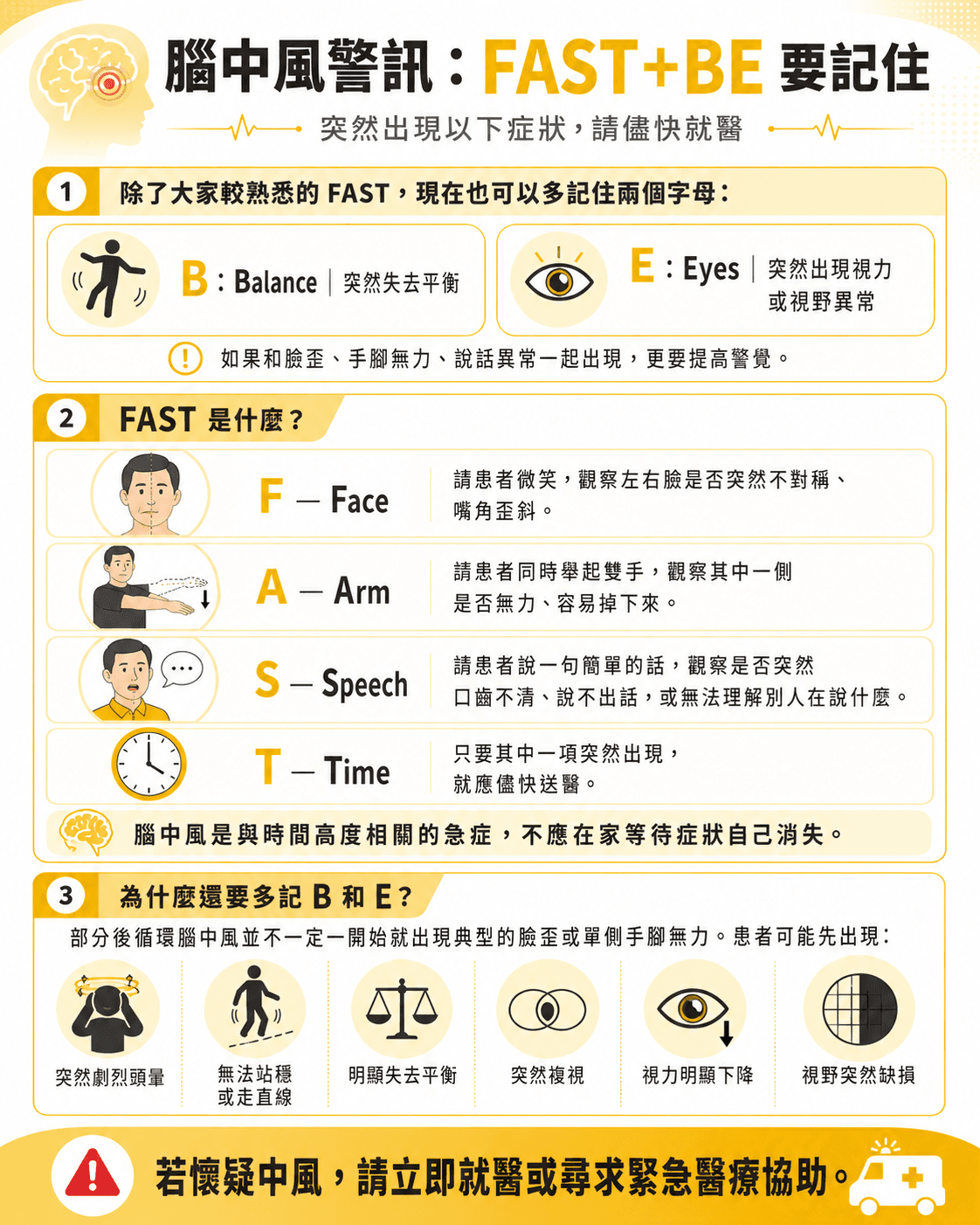
In addition to the more familiar FAST, you can now memorize two extra letters:
B: Balance — Sudden loss of balance
E: Eyes — Sudden vision changes or visual field defects
If these occur alongside facial drooping, arm or leg weakness, or slurred speech, you must be even more vigilant.
What is FAST?
FAST is a commonly used mnemonic for recognizing stroke symptoms:
F — Face
Ask the person to smile. Observe if one side of the face suddenly droops or if the mouth is crooked.
A — Arm
Ask the person to raise both arms. Check if one arm drifts downward or is weak.
S — Speech
Ask the person to repeat a simple phrase. Listen for slurred or strange speech, or an inability to understand what others are saying.
T — Time
If any of these signs suddenly appear, seek medical attention immediately.
A stroke is a time-critical medical emergency; do not wait at home for symptoms to disappear on their own.
Why Memorize B and E as Well?
Some posterior circulation strokes do not necessarily present with typical facial drooping or one-sided arm and leg weakness at onset.
Instead, patients may first experience:
Sudden severe dizziness
Inability to stand steadily or walk in a straight line
Significant loss of balance
Sudden double vision
A noticeable drop in vision
Sudden visual field defects
Therefore, paying attention to Balance and Eyes in addition to FAST can help identify strokes with atypical presentations.
The key remains "sudden onset."
If someone who normally walks fine suddenly cannot stand steadily, cannot see clearly within minutes, and has accompanying neurological symptoms, it is not appropriate to treat it as ordinary dizziness and rest at home.
Dizziness Isn't Always a Stroke, but Identify Dangerous Patterns First
There are many causes of dizziness.
Benign paroxysmal positional vertigo (BPPV), orthostatic hypotension, inner ear disorders, neck blood vessel issues, medications, or neurological problems can all cause different types of dizziness.
Therefore, "having dizziness" itself cannot directly determine whether a stroke has occurred.
What requires closer attention is:
Did it happen suddenly?
Is it accompanied by unsteady walking?
Is there double vision, difficulty swallowing, or slurred speech?
Is there weakness or numbness on one side of the body?
Is there a new, severe headache?
If these neurological warning signs are present, emergency conditions like stroke should be ruled out first.
If, on the contrary, the symptoms are highly specific—for example, "dizzy only when turning to a certain angle, and it improves when the head returns to center"—that points to a different diagnostic direction, and an evaluation of the neck and vertebral artery blood flow may be needed.
Why Pay Extra Attention to Blood Pressure in Cold Winter Weather?
In the NOW Health report, Dr. Lu Ping-sheng reminded that cold weather increases sympathetic nervous system activity and constricts peripheral blood vessels, which may lead to elevated blood pressure.
For those who already have high blood pressure, diabetes, high cholesterol, a smoking habit, or are at risk for cardiovascular and cerebrovascular diseases, it is even more vital to manage blood pressure and treat existing chronic conditions.
In winter, physical inactivity or changes in drinking habits can also cause people to overlook their physical condition.
However, the core of stroke prevention does not rely on a single food item, health supplement, or self-medication.
Instead, it involves:
Controlling blood pressure according to medical advice
Managing blood sugar and lipids
Quitting smoking
Exercising regularly
Drinking sufficient water based on individual physical needs
Taking prescribed medications as directed by a physician
Regularly monitoring cardiovascular and cerebrovascular risk factors
Antiplatelet or anticoagulant medications are not suitable for everyone; do not start taking them on your own out of fear of a stroke.
Dr. Lu Ping-sheng: From Acute Stroke to Post-Stroke Functional Recovery
Dr. Lu Ping-sheng has a background in diagnostic imaging, neuroradiology, and pain management, and has long been dedicated to endovascular therapy for acute stroke and neurological functional recovery.
When it comes to stroke, treatment can be divided into two completely different phases.
The first phase is acute rescue.
The goal is to restore brain blood flow as quickly as possible in eligible patients to minimize progressive brain tissue damage.
The second phase is post-stroke functional recovery.
Even if blood vessels are successfully reopened during the acute phase, some patients may still experience sequelae such as limb weakness, unsteady gait, and reduced hand function, requiring subsequent rehabilitation and comprehensive functional assessment.
Both phases are important, but their treatment goals are different.
If FAST+BE Suddenly Appears, Do Not Try to Book an Outpatient Appointment
This point requires special emphasis.
If the following symptoms suddenly appear right now:
Facial drooping, one-sided arm or leg weakness, slurred speech, sudden loss of balance when walking, or sudden vision abnormalities,
please seek emergency medical services directly.
Do not wait for a regular outpatient clinic, and do not drive yourself to a clinic.
If acute emergencies have been ruled out, but you still experience recurrent dizziness triggered by specific postures, vision darkening when turning your neck, or persistent neurological issues following a stroke, those fall within the scope of further outpatient evaluation.
Further Reading
Dizzy Only When Turning Your Head and Better When Straightened? When to Examine Neck Blood Vessels
Can Neck Massage Cause a Stroke? When to Pay Attention to Neck Vascular Risks
Media Source: NOW Health
Original Report Date: December 19, 2025
Original Report Title: Peak Season for Winter Strokes! Memorizing the "FAST+BE" Advanced Mnemonic Helps Save Lives
Interviewed Physician: Dr. Lu Ping-sheng, Director of Heal-Easy Clinic
Acute neurological symptoms indicated by FAST+BE serve as emergency recognition guidelines and cannot replace emergency medical evaluations. If you suspect a stroke, please seek emergency medical assistance as quickly as possible.
