Is surgery necessary for sciatica? What treatments to try first and when to consider surgery
Is surgery necessary for sciatica? What treatments to try first and when to consider surgery
Article Summary
"Whether surgery is needed" is one of the most common questions asked by sciatica patients. The answer is: in most cases, there is no need to rush into surgery, but there are a few situations that cannot wait.
This article explains the sequence of treatment - what we can do first, when to consider prolotherapy, and under what circumstances surgery is required. To understand the causes of sciatica, please see the sciatica topic article on this site; to confirm whether you have sciatica, please see "How to Confirm Sciatica".
Does sciatica definitely require surgery?
No, in most cases. Not all patients must undergo surgery. Clinically, doctors usually start with conservative treatment first, such as lifestyle adjustments, medication, and rehabilitation, and then observe the response for six to eight weeks. Most patients' symptoms will gradually improve during this period. Surgery is an option to be evaluated only when conservative treatment is ineffective or when specific warning signs appear; it is not the first step.
What are the non-surgical treatments?
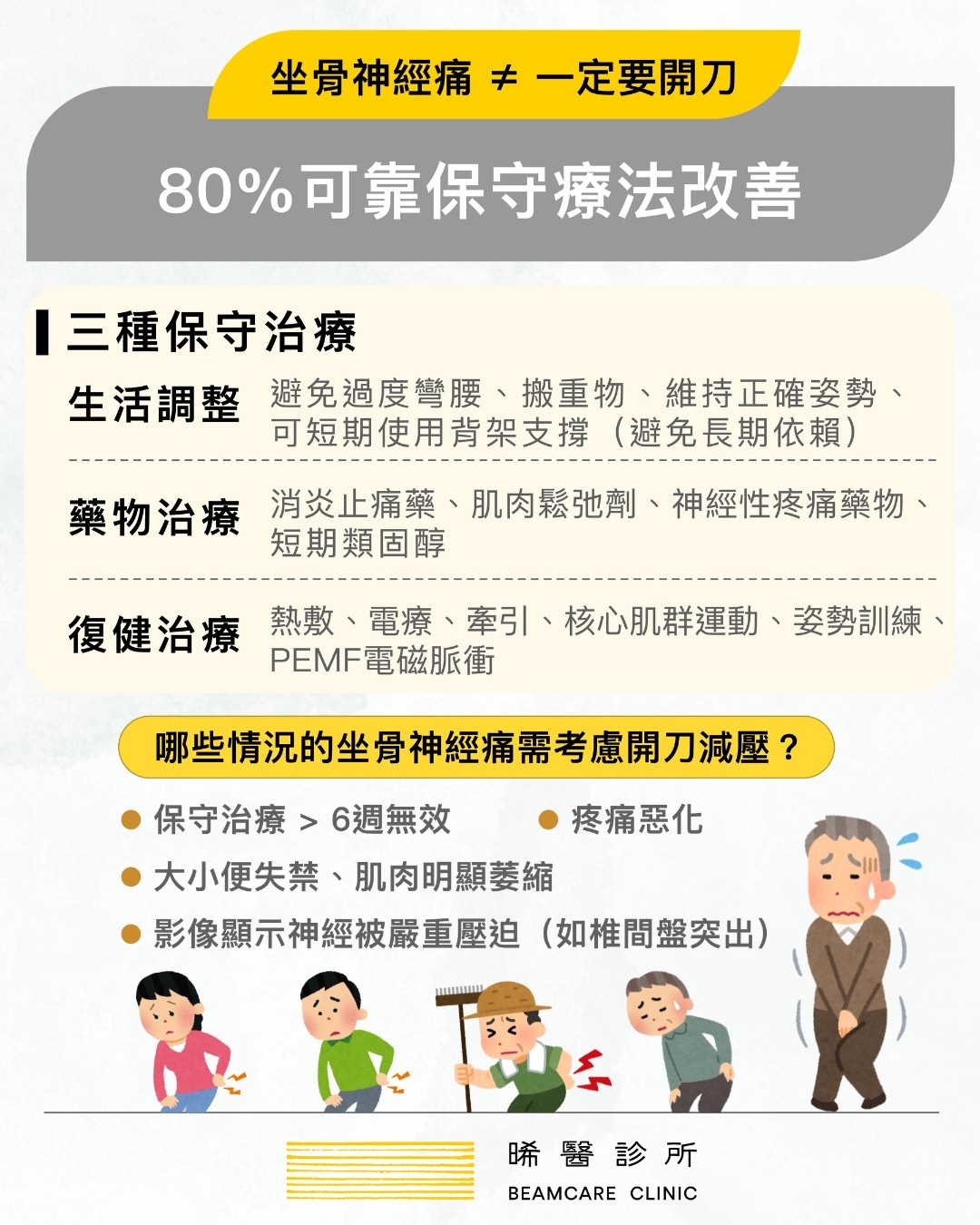
Lifestyle adjustments form the foundation of improvement: during the acute episode phase, please avoid excessive activity and reduce movements that increase spinal pressure, such as significant bending and heavy lifting, while maintaining correct standing, sitting, and sleeping postures.
When pain is pronounced, a back brace can be used for short-term support, but long-term reliance is not recommended. The main reason is that long-term use may lead to the degeneration of deep spinal muscles (transversospinalis muscle group), which conversely compromises lumbar spine stability.
Regarding medication, oral anti-inflammatory painkillers and muscle relaxants are used to relieve symptoms. If prominent neuropathic pain symptoms such as soreness, numbness, tingling, and pain occur, doctors may use tricyclic antidepressants or anticonvulsants; short-term steroids are also an option. The choice and duration of medication are determined by the doctor based on symptoms.
Rehabilitation therapy includes hot packs, electrotherapy, exercise therapy, and posture education. Trunk stretching exercises and back relaxation help relieve muscle tightness, while lumbar traction is used to reduce disc pressure and widen the intervertebral foramina. Shine Clinic uses German Zimmer electromagnetic pulse equipment to stimulate deep muscle groups as one of the auxiliary tools for rehabilitation.
Under what circumstances should surgery be considered?
Surgery can be considered in two situations.
First, after continuing conservative treatment for a certain period, the pain persists without improvement or even worsens, and imaging exams show obvious herniated discs or spinal stenosis compressing nerves. At this time, you should discuss decompression surgery with a neurosurgeon or spine surgeon to avoid irreversible damage to the nerves. Second, if symptoms of severe nerve damage appear, such as muscle atrophy in the lower limbs, please undergo a surgical evaluation as soon as possible.
Special distinction must be made for emergency warning signs: bowel or bladder incontinence, difficulty urinating, perineal numbness, and obvious lower limb weakness. These three conditions do not fall under the category of "arranging a time for evaluation"; please seek medical attention immediately. For a detailed explanation of the warning signs, please see "How to Confirm Sciatica".
What is prolotherapy? Where does it fit in the treatment sequence?
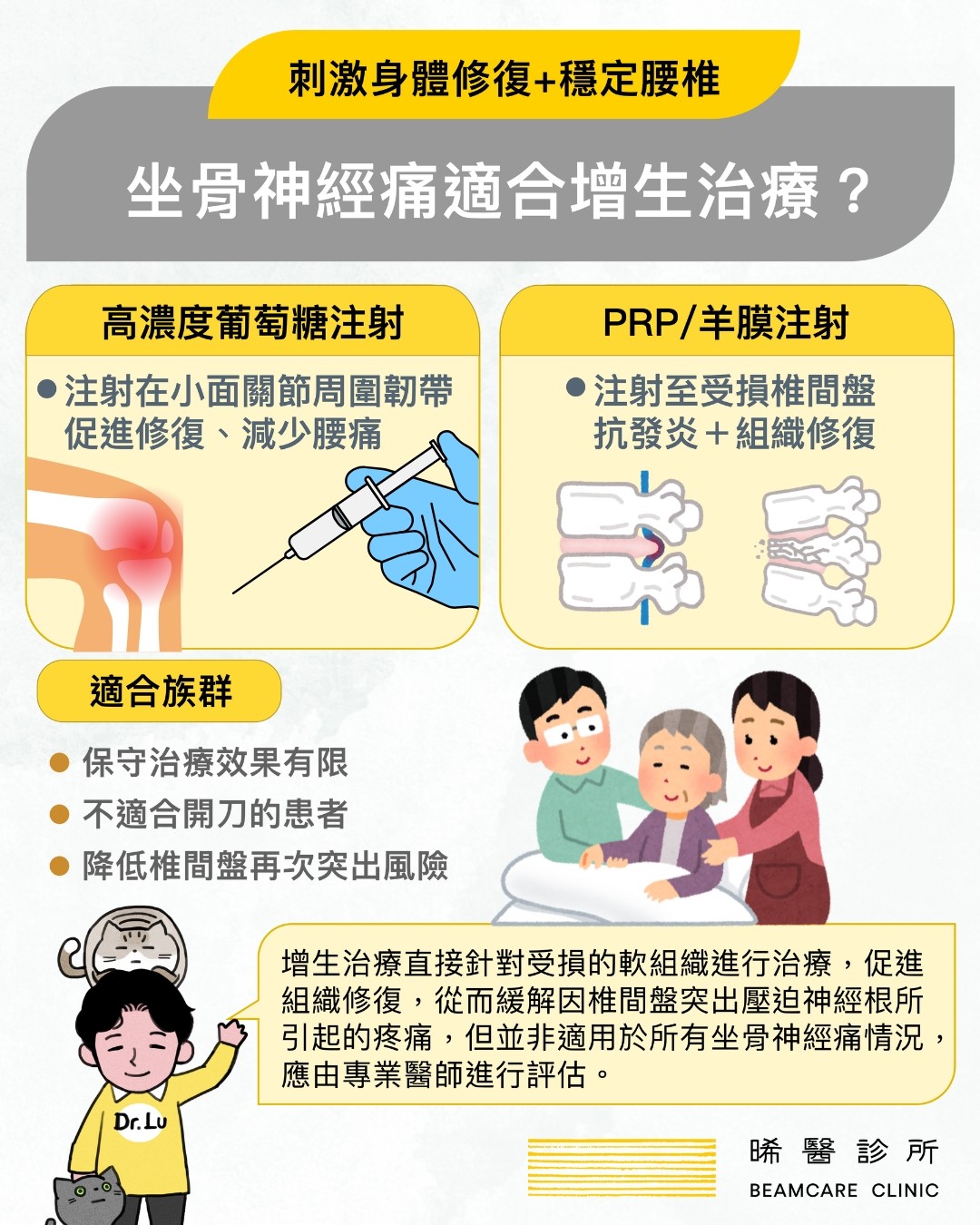
The purpose of prolotherapy is to stimulate the body's repair mechanisms, promote soft tissue repair, and thereby stabilize the lumbar spine. Here are a few common examples: high-concentration dextrose injection, which is injected into the ligaments around the lumbar facet joints under ultrasound guidance, aiming to promote ligament repair and stabilize the lumbar spine; PRP (Platelet-Rich Plasma) injection, which turns one's own platelets into plasma rich in growth factors and injects it near the damaged tissue, aiming to reduce inflammation and assist in tissue repair.
Its position in the sequence is usually at a stage where conservative treatment has limited effectiveness but surgery is not yet required (or temporarily not considered). Prolotherapy has its applicable conditions and is not suitable for all sciatica cases. Whether to adopt it, as well as the injection sites and frequency, needs to be evaluated by a doctor based on the medical condition and imaging.
Are there other non-surgical options?
Yes.
Depending on the cause and location of the pain, other options such as catheter-based interventional therapy may also be included in the evaluation. For a complete summary of treatment methods, please see the Sciatica topic article on this site. If your lower back and leg pain has persisted for some time and conservative treatment has achieved limited results, you can first undergo prior evaluation and make an appointment via LINE. Please bring your imaging data (X-ray, MRI) and treatment records during your consultation, so the doctor can confirm the location and extent of compression, and then explain the appropriate next step.
Contributing Physician: Dr. Ping-Sheng Lu
Disclaimer: This article is for health education information purposes and cannot replace a doctor's diagnosis and treatment advice. If the emergency warning signs described in this article occur, please seek medical attention immediately.
