
Why do young people also get sciatica? How do the causes differ from those in older adults?
Why do young people also get sciatica? How do the causes differ from those in older adults?
Article Summary
Sciatica is often considered an issue for older adults. However, there are many patients in their thirties and forties, and even some in their twenties, in outpatient clinics.
The reasons why young people and older adults experience pain are actually quite different, and consequently, the focus of management also differs. This article discusses the younger demographic. To see the full causes and treatment options, please refer to our website's sciatica topic article.
Why do young people get sciatica too?
It has less to do with age and more to do with how much pressure the lumbar spine endures daily.
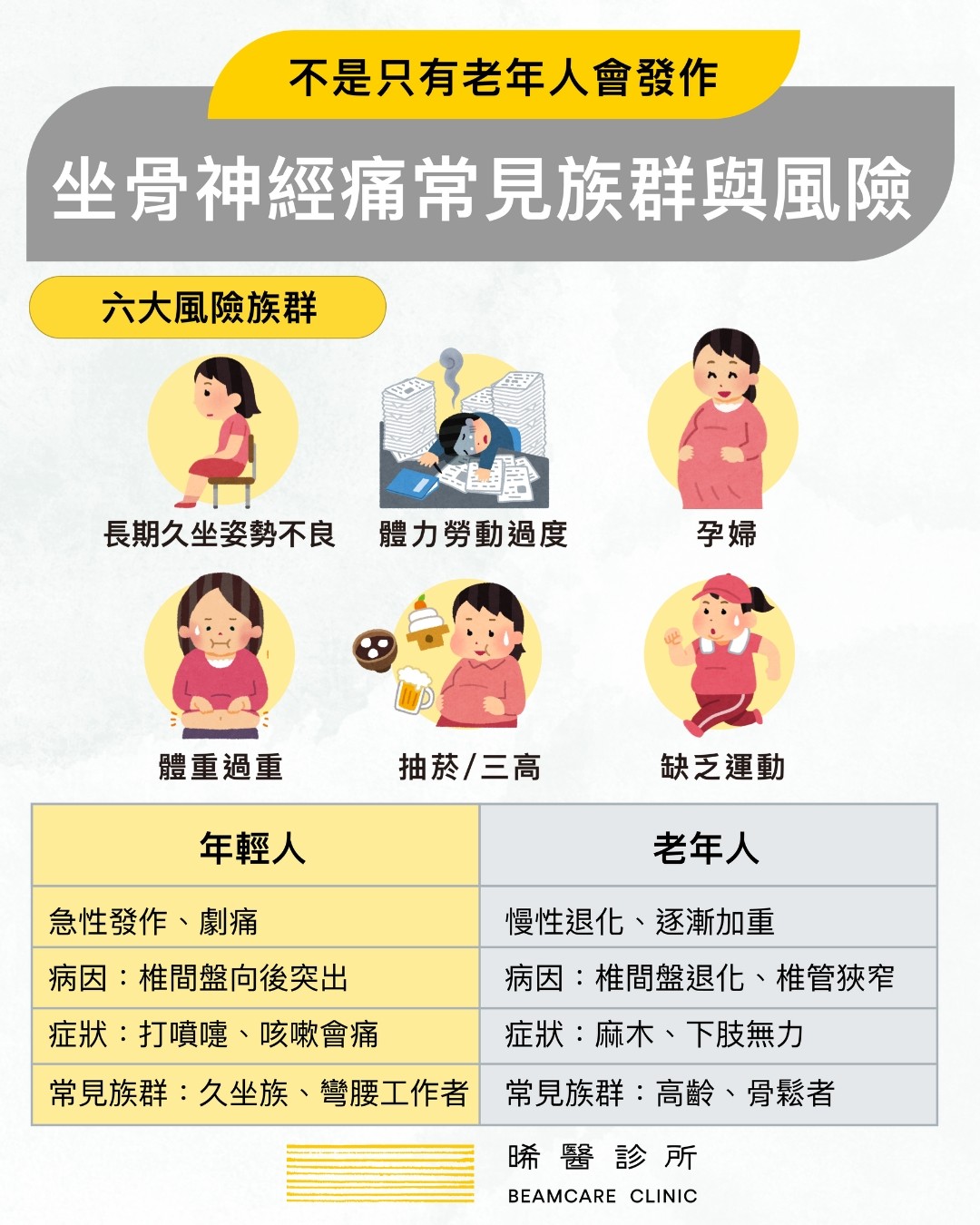
Common types of people seen in clinics include office workers who sit for more than eight hours a day, drivers who hold the steering wheel for long periods, and manual laborers who need to repeatedly lift heavy objects. Pregnant women are also included, as fetal growth changes the way stress is applied to the lumbar spine.
Risk factors are concentrated in several areas. Prolonged sitting and slouching, being overweight, core muscle strength insufficient to support the spine, and standing for long periods or overusing the waist. Smoking and three-hypers (hypertension, hyperglycemia, hyperlipidemia) are also among them; these affect the conditions for tissue repair.
Repeatedly lifting heavy objects is cumulative; doing it once is fine, but doing it for a few years can trigger a herniated disc or nerve compression.
Is having an exercise habit enough to prevent problems?
Not necessarily.
Regular exercise does indeed help stabilize the lumbar spine, but incorrect training methods can also lead to symptoms. Training at too high an intensity, improper posture, core strength not keeping up, and excessively arching the back during movements can all increase pressure on the spinal discs.
When changing training routines or adding weight, the quality of movement and the way force is generated are more worthy of attention than the weight itself.
What is the difference between sciatica in young people and older adults?
The difference lies in the mechanism, which directly affects how the pain feels.
The younger group mostly experiences acute posterior disc herniation. The herniated disc irritates the surrounding nerves and causes inflammation, so the pain is more acute and intense. It is common in people who bend over, lift heavy objects, or sit for long periods. The pain radiates, extending from the lower back to the buttocks and legs; movements that increase abdominal pressure, such as coughing, sneezing, and bending over, make the pain more pronounced.
Older adults are different. Most cases involve degenerative changes such as disc degeneration or lumbar spinal stenosis. The disease course is slow but gradually worsens, presenting as intermittent or continuous pain, often accompanied by numbness and weakness in the lower limbs. Older adults have a higher risk of osteoporosis, and if combined with vertebral compression fractures, it can also cause sciatica.
In addition, there is another matter worthy of attention for the younger demographic. Leaving it untreated for a long time can not only cause premature degeneration of the lumbar joints but is also often combined with tension imbalances in the pelvis and deep gluteal muscles. This part needs to be evaluated together; otherwise, even after the disc treatment is complete, the root cause of the pain remains.
How will the treatment be arranged?
Most begin with conservative treatment.
Regarding medication, non-steroidal anti-inflammatory drugs (NSAIDs), muscle relaxants, or neuromodulating medications are commonly used. When symptoms are more pronounced, physicians may arrange short-term oral steroids or local steroid injections to reduce nerve root irritation. What to use and for how long will be determined by the physician based on symptoms.
Rehabilitation is an important part. Under the guidance of a physical therapist, perform core muscle strengthening and flexibility training, such as the bridge pose and cat-cow stretch, paired with aerobic exercise like walking or swimming. Please have a physician or therapist confirm the movements and intensity first, as doing the wrong movements during the acute phase can worsen the condition.
When conservative treatment has limited effects, injection therapy will be evaluated. Regenerative therapy (such as platelet-rich plasma PRP, amniotic fluid, BMAC, etc.) aims to assist in the repair of damaged tissues around the disc. However, clinical data for this type of treatment on disc pathways is still accumulating. The layer to which it can treat and whether it is suitable requires a physician to review images before explaining the treatment plan. For a more complete treatment sequence, please see "What are the treatment choices for chronic pain?".
Under what circumstances should surgery be considered?
If conservative treatment fails to improve the condition, and persistent lower limb weakness or sensory abnormalities occur—manifesting as nerve function impairment—an evaluation will be made to determine if surgery is needed to relieve the compression. For the criteria and treatment sequence, please see "Is surgery required for sciatica?".
In addition, please seek medical attention immediately for these three conditions without further observation: fecal or urinary incontinence or difficulty urinating, numbness in the perineum (groin, saddle area), and obvious weakness in the lower limbs or rapid muscle atrophy.

What adjustments can be made in daily life?
Start with sitting posture, as that is where sedentary groups accumulate the most stress throughout the day.
Choose a chair with lumbar support, maintain an ergonomic sitting posture, avoid staying in the same position for a long time, and get up to walk around and stretch at regular intervals. When lifting heavy objects, bend your knees instead of bending your waist, and do not twist with your waist when turning.
These sound like trivial details. However, for people who sit for eight to ten hours a day, reducing the accumulated pressure on the lumbar spine is much easier to achieve than treating it afterwards.
If the pain has repeatedly occurred, it is recommended to have a physician confirm the cause before deciding what to adjust.
Would you like an evaluation?
You can complete a pre-evaluation through LINE first, and bring past imaging data (X-rays, MRI) and treatment records during your consultation. Si-Yi Clinic is located at 2F-1, No. 40, Sec. 2, Heping E. Rd., Da'an Dist., Taipei City, and operates fully by appointment. Phone: (02) 2366-0186.
Authoring Physician: Dr. Ping-Sheng Lu
Last Updated: July 26, 2026
Disclaimer: This article is for health education purposes and cannot replace medical diagnosis and treatment advice. The suitability of any treatment should be evaluated and decided by a physician. If any urgent warning signs mentioned in the text appear, please seek medical attention immediately.
