
What Should You Do About Wrist Pain? 7 Common Causes of Wrist Pain, Pain Locations, and Relief Methods: A Complete Guide
What Should You Do About Wrist Pain? 7 Common Causes of Wrist Pain, Pain Locations, and Relief Methods: A Complete Guide
Article Summary
Wrist pain—what should you do? Which specialist should you see? This article starts with the structure of the wrist, explains 7 common causes of wrist pain, tells you what different wrist pain locations may indicate, shares 5 ways to relieve wrist pain, and finally recommends Xi Yi Clinic, which offers comprehensive examinations and one-stop pain treatment services!
1. Why does bending or rotating the wrist hurt? An explanation of wrist pain locations and causes!
The wrist is an important joint we use frequently in daily life. Whether typing, carrying things, brushing your teeth, exercising, or more, we rely on the wrist joint. Once wrist pain appears, it is not only unbearable, it also greatly reduces quality of life.
There are many possible causes of wrist pain. Common conditions that clinically tend to cause wrist pain include the following:
Ligament injury: Due to overextension, sprains, or tears, the wrist will immediately develop severe pain and swelling, and may even feel unstable or locked.
Arthritis:
1. Osteoarthritis: Wear and tear of the joint cartilage causes bone friction, leading to inflammation and pain.
2. Rheumatoid arthritis: The wrist joint often shows symmetrical inflammation and swelling, accompanied by morning stiffness and limited movement.
3. Gouty arthritis: Uric acid crystals deposit in the joint, causing sudden severe redness, swelling, warmth, and pain.
Carpal tunnel syndrome: Compression of the median nerve causes numbness, tingling, or weakness in the thumb, index finger, middle finger, and part of the ring finger.
Ganglion cyst: A lump appears on the wrist, usually not painful, but it may cause discomfort if it compresses a nerve or during movement.
Basal joint arthritis: Inflammation at the junction between the thumb and the wrist bones causes obvious pain at the base of the thumb when pinching, gripping, or rotating.
Stenosing tenosynovitis: Overuse of the thumb tendon leads to inflammation, and pain worsens with movement or gripping.
Triangular fibrocartilage complex (TFCC) injury: Pain on the little-finger side of the wrist, possibly accompanied by catching sensations or reduced grip strength.
Below, we’ll help you understand the possible conditions, triggers, and at-risk groups for different wrist pain locations.
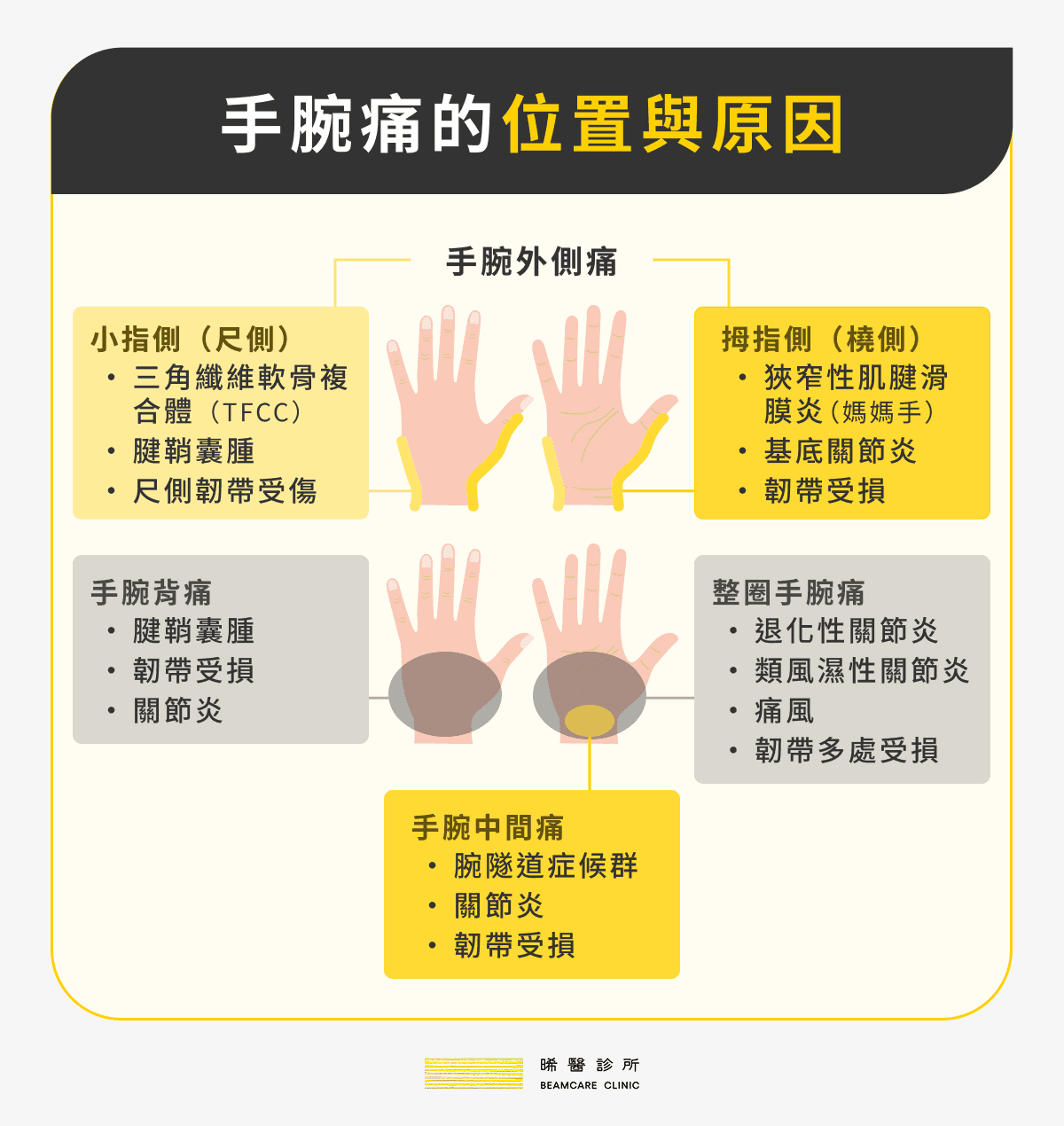
📝 Pain on the outer side of the wrist
Pain on the outer side of the wrist is often related to the tendons, ligaments, and joint structures on the thumb side (radial side) or little-finger side (ulnar side). Different sides may respond differently when rotating, bending, or weight-bearing on the wrist, so the location can help roughly indicate the possible condition.
[Thumb side (radial side)]
Possible conditions: Stenosing tenosynovitis (De Quervain's tenosynovitis), basal joint arthritis, ligament injury
Symptoms: Pain when bending or rotating the thumb, weakness when pinching, discomfort when gripping or opening jars
Triggers: Carrying a baby, scrolling on your phone, typing for long periods, excessive pinching or gripping
At-risk groups: New parents, homemakers, heavy smartphone/computer users, bank tellers, and assembly-line workers
[Little-finger side (ulnar side)]
Possible conditions: Triangular fibrocartilage complex (TFCC) injury, ganglion cyst, ulnar ligament injury
Symptoms: Pain when supporting your body on the ground, turning the steering wheel, or twisting a towel, possibly accompanied by a clicking or catching feeling
Triggers: Falling and catching yourself with your hand, twisting motions in ball sports
At-risk groups: Ball-sports players (badminton, tennis), fitness enthusiasts, and people who need to carry loads or hold tools
📝 Pain in the middle of the wrist
Central wrist pain is often related to nerve compression or load on the central joint, and it commonly worsens with wrist bending, long hours at the computer, or repeated use of the hand. If numbness or weakness is present, nerve-related problems should be considered.
Possible conditions: Carpal tunnel syndrome, arthritis, ligament injury
Symptoms: Pain when bending the wrist, nighttime hand numbness (slightly relieved after shaking the hand), weak grip
Triggers: Extensive typing, scrolling on your phone, repetitive hand work, inflammation causing nerve compression
At-risk groups: Heavy phone users, cashiers and office workers, and people with metabolic issues such as diabetes or hypothyroidism
📝 Pain on the back of the wrist
The back of the wrist contains many tendons and ligaments, so pain is more likely to appear when weight-bearing on the hand, doing push-ups, or extending the wrist backward. If there is a lump on the back side, it is often related to a ganglion cyst.
Possible conditions: Ganglion cyst, ligament injury, arthritis
Symptoms: Pain when bending the wrist backward, discomfort when weight-bearing on the hand, soreness or tingling from a lump on the back side
Triggers: Falling and catching yourself with your hand, overuse in yoga or fitness, long hours using a keyboard and mouse
At-risk groups: Keyboard users, carpenters and repair workers, fitness and yoga enthusiasts, and teenagers
📝 Pain around the whole wrist
When pain is distributed around the entire wrist, it usually means that multiple wrist structures are affected, including the joints, ligaments, and synovial system. This type of pain is often more obvious when rotating the wrist, supporting the body, or doing push-type movements.
Possible conditions: Osteoarthritis, rheumatoid arthritis, gout, multiple ligament injuries
Symptoms: Stiffness, swelling, and warmth around the wrist, with widespread pain during rotation and weight-bearing
Triggers: Chronic wear and tear, autoimmune disease, acute sprains, or repetitive overuse injuries
At-risk groups: Manual laborers who carry loads, menopausal women, people with rheumatoid disease, people prone to gout, and those with a history of wrist injury
Are you troubled by wrist pain? Let Xi Yi Clinic help you identify the root cause and create a personalized treatment plan! |
2. What should you do about pain on the outer side of the wrist? A summary of ways to relieve wrist pain
If it is not an acute, severe injury (such as an obvious fracture, severe swelling, or inability to move), you may consider the following ways to relieve and improve symptoms:
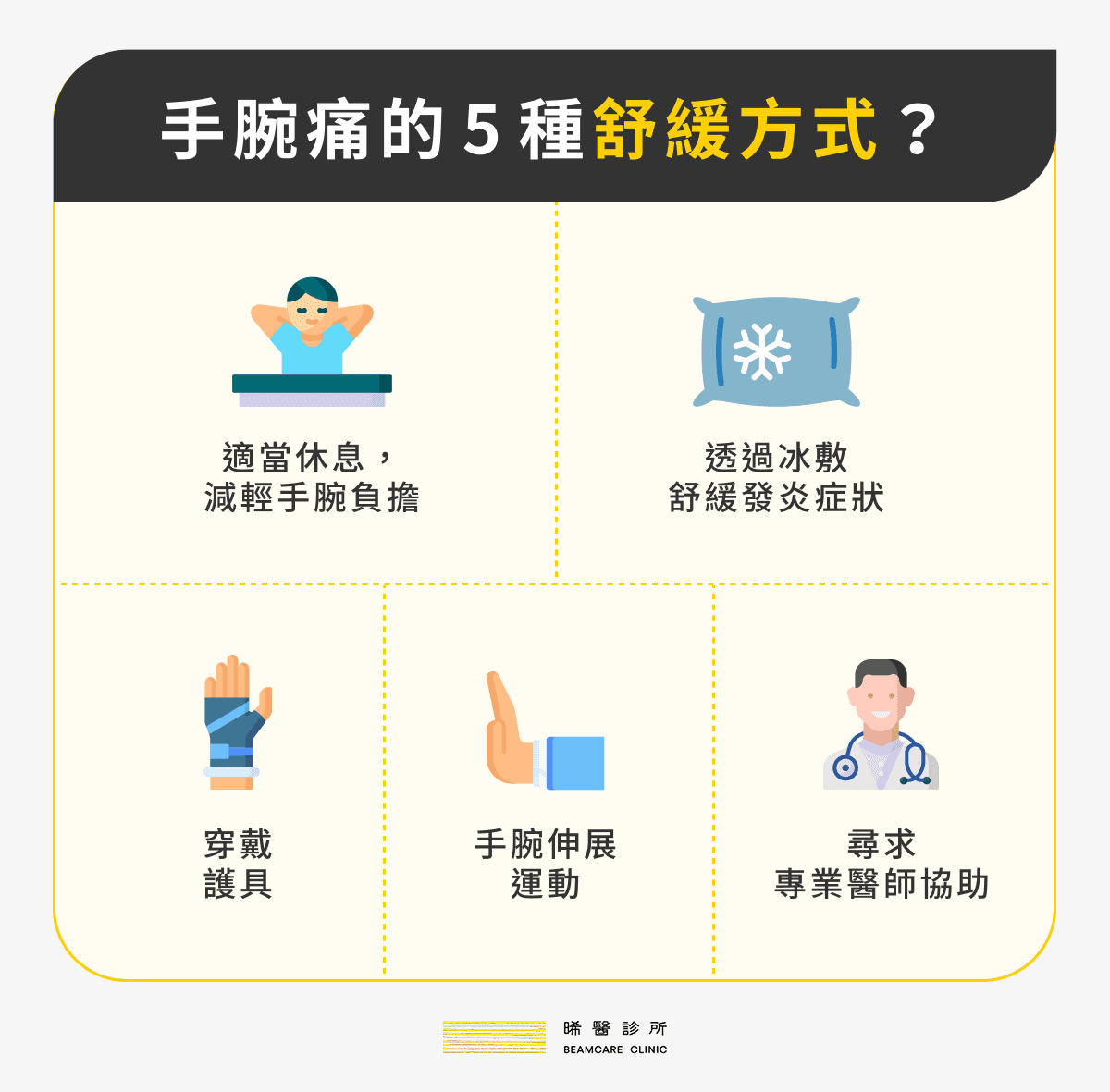
(1) Rest properly and reduce the load on the wrist
Give the wrist enough rest and avoid repetitive motions or activities that worsen pain, such as repeatedly twisting the wrist (wringing towels), gripping or carrying heavy objects for long periods, or bearing weight on a wrist bent backward (weight-bearing on the ground, push-ups). This can effectively reduce the load on the wrist and give injured tissues a chance to heal themselves. This is the most basic and important way to relieve symptoms.
(2) Use ice to ease inflammation
If the wrist suddenly becomes painful, red, or swollen, ice can help reduce inflammation. Wrap an ice pack in a towel and apply it to the painful area for about 15 to 20 minutes each time, 3 to 4 times a day. Avoid direct contact between the ice pack and the skin to prevent frostbite.
(3) Wear support braces
Appropriate supports, such as a wrist brace or thumb spica, can provide extra support and stabilization for the wrist, limit unnecessary movement, reduce pain, and speed up tissue healing.
When choosing a support, make sure it fits properly and does not put excessive pressure on the hand or affect blood circulation. If you need to wear it for long periods of time (such as at work or while resting), you may also want to choose a breathable material to avoid discomfort caused by heat or moisture.
(4) Wrist stretching exercises
Moderate wrist stretching exercises help maintain joint mobility, increase tendon flexibility, and improve blood circulation. Here are some simple stretching exercises:
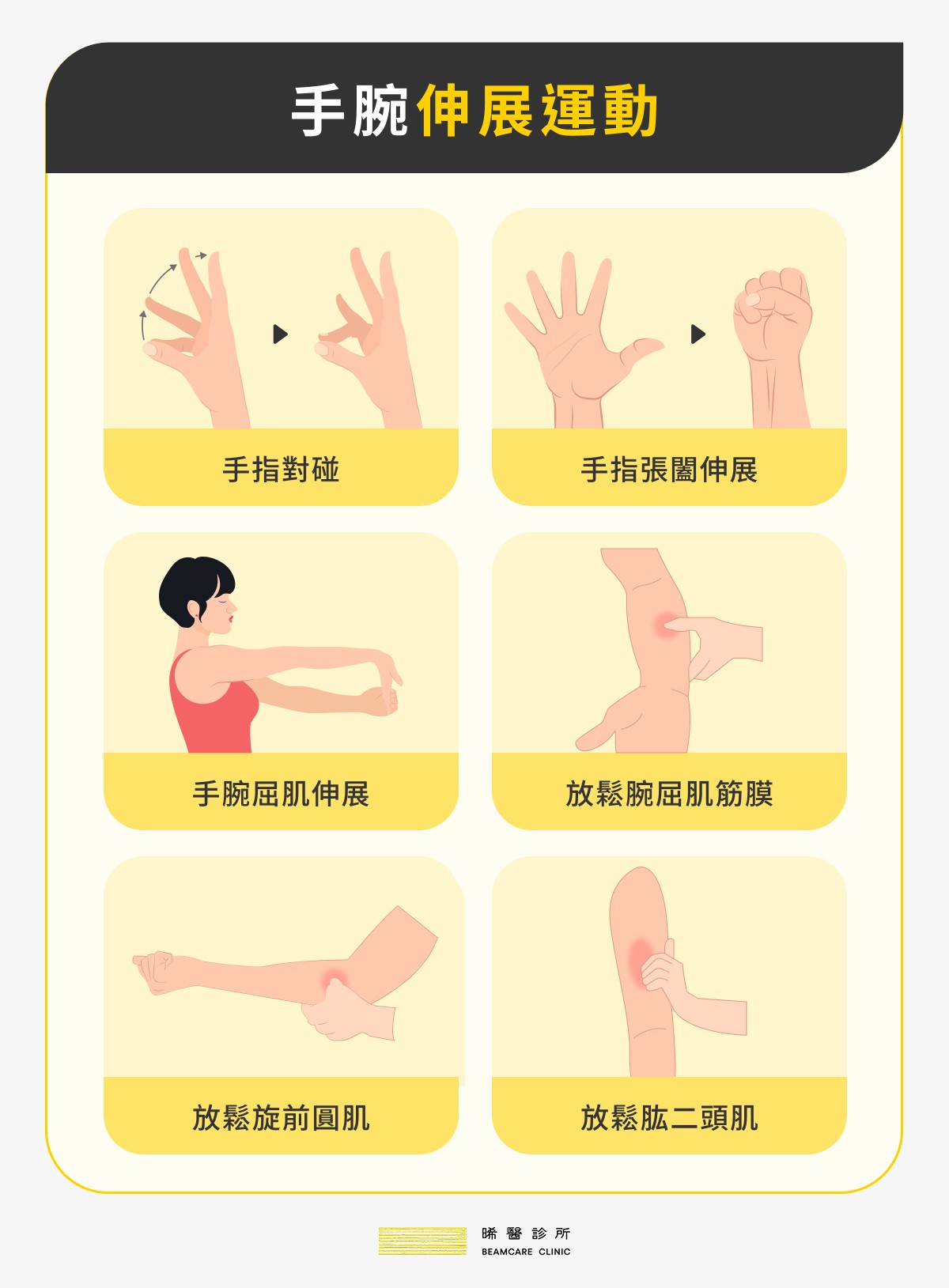
Finger-to-thumb touch: Gently touch each fingertip to the thumb tip in sequence to help relax the finger muscles and improve flexibility.
Finger open-and-close stretch: Open the palm as wide as possible, then clench it into a fist. This stretches the muscles of the hand and forearm.
Wrist flexor stretch:
1. Extend one arm straight forward with the palm facing up.
2. Use the other hand to hold the fingers of the extended hand and gently press them downward so they point toward the floor until you feel a slight stretch in the forearm.
3. Hold for 15 to 30 seconds, repeat 3 to 4 times, then switch hands.
Relax the wrist flexor fascia:
1. Fully extend the arm with the palm facing up and the fingers pointing toward the floor.
2. Press along the tight muscle groups on the inner forearm, slowly moving from near the elbow toward the wrist.
Relax the pronator teres
1. Use your thumb to press a point about one finger-width below the elbow, and find especially sore or tight spots by pressing.
2. While maintaining pressure on the sore spot, slowly rotate the forearm.
3. Rotate from palm up to palm down, then back from palm down to palm up; that counts as one repetition. Repeat 10 times for this sore spot.
Relax the biceps
1. Bring four fingers together and press down on the biceps (the front of the upper arm, between the elbow and shoulder).
2. Keep the same downward pressure, then use those four fingers to push toward the elbow at the same time. Slowly extend and bend the forearm.
3. Repeat 10 times for one set; it is recommended to do 3 sets a day.
(5) Seek professional medical treatment
If wrist pain has not improved after more than 2 weeks, if there is obvious swelling or wrist deformity, numbness, tingling, weakness, limited movement, or if symptoms still do not improve after the home-relief measures above, please seek a professional diagnosis from a doctor as soon as possible. The doctor will perform a detailed examination to identify the exact cause of the pain and provide the most appropriate treatment plan. Common treatment options are as follows:
[Non-drug treatment and habit adjustment]
The first step in treatment is usually to ask the patient to adjust daily habits. The doctor will explain which movements can injure the wrist and recommend ergonomic aids (braces, ergonomic mice, etc.) to fundamentally reduce ongoing damage to the wrist.
At the same time, physical therapy and occupational therapy are needed to help the wrist recover. In addition to specialized equipment to reduce inflammation and pain, massage and movement exercises (manual therapy) are also used to help tight fascia and joints regain flexibility. If necessary, a brace or splint may be worn to immobilize the wrist, giving injured tissues enough time to rest, but remember not to wear it for too long, or the muscles may weaken.
[Medication and injection treatment]
When basic treatment is not very effective, medication may be considered to speed up symptom relief. Anti-inflammatory painkillers are usually used first to control inflammation. If pain persists, the doctor may perform precise injections with ultrasound guidance.
Injection options include regenerative therapies used to stimulate tissue repair (such as high-concentration glucose or PRP) to help repair ligaments and cartilage. In addition, steroids can be used for rapid pain relief, but because they may have long-term effects on tissues, they are used less frequently now.
[Surgical treatment]
Surgery is usually the last option. It is considered only if pain persists for more than 6 months, all other methods have failed, or nerve compression has already caused severe weakness in the hand.
Common surgical types include decompression surgery for carpal tunnel syndrome; tendon sheath release for De Quervain's tenosynovitis; or minimally invasive arthroscopic procedures to repair cartilage or ligament injuries.
Are you troubled by wrist pain? Let Xi Yi Clinic help you identify the root cause and create a personalized treatment plan! |
3. Which specialist should I see for wrist pain? Decide the right department based on the cause of the wrist pain
The causes of wrist pain can be very diverse, ranging from chronic overuse of tendons or ligaments to damage to bones, joints, or nerves, and even autoimmune diseases can cause discomfort. Different causes require different specialties and treatments. If you choose the wrong department, not only may treatment be delayed, symptoms may also worsen.
To quickly determine which department to visit for wrist pain, you can refer to the table below:
Recommended department | Suitable situation | Key symptoms and criteria |
Orthopedics | Acute trauma, structural injury, severe degeneration. | Fractures, dislocations, arthritis, or severe structural problems. Treatment usually involves medication or surgery. |
Rehabilitation Medicine | Chronic overuse injuries, soft tissue inflammation, functional recovery. | Chronic soft tissue pain such as De Quervain's tenosynovitis or tendinitis; rehabilitation is needed to restore normal hand function. |
Neurology / Neurosurgery | Conditions related to nerve compression or injury. | Wrist pain accompanied by numbness, tingling, or unusual weakness in the fingers or palm, and other nerve symptoms (for example, carpal tunnel syndrome). |
Rheumatology / Immunology | Arthritis caused by autoimmune disorders. | Diagnosed or suspected rheumatoid arthritis, gout, and other autoimmune diseases that require treating the underlying systemic inflammation. |
4. Still not sure what to do about wrist pain? Choose Xi Yi Clinic for one-stop treatment!
After reading the above introduction, are you still unsure about the cause of your wrist pain or which department to visit? Come to “Xi Yi Clinic,” and you won’t have to worry about choosing anymore. Let our professional team create the most suitable treatment plan for you!
Located near Daan Forest Park in Taipei, Xi Yi Clinic is led by pain treatment expert Dr. Lu Bing-Sheng and brings together professionals from orthopedics, Chinese medicine, nutrition, fitness, and other fields to resolve all kinds of acute and chronic pain problems.
In particular, for common finger joint pain, stiff neck, upper back pain, frozen shoulder, sciatica, or other occupational injuries, chronic pain, and similar conditions, the clinic provides comprehensive and personalized care.
Features and advantages of Xi Yi Clinic
✅ Integrated multi-specialty assessment: Whether the issue is musculoskeletal, nerve-related, or joint degeneration, the team’s integrated evaluation can precisely identify the root cause of wrist pain.
✅ Minimally invasive, scalpel-free treatment: Using image-guided techniques combined with regenerative medicine, functional medicine, and personalized rehabilitation plans, the clinic gently and effectively repairs tissues, helping reduce recovery time and improve symptoms without surgery.
✅ Full陪伴 and care: From detailed diagnosis to treatment follow-up, Xi Yi Clinic does more than address local pain; it provides comprehensive care that integrates body and mind, accompanying you every step of the way and helping your body restart its self-healing ability.
Whether you are middle-aged or older, an occupational injury patient, or a sports enthusiast, if you are suffering from wrist pain, Xi Yi Clinic can offer you a brand-new treatment option!
Are you troubled by wrist pain? Let Xi Yi Clinic help you identify the root cause and create a personalized treatment plan! |
